

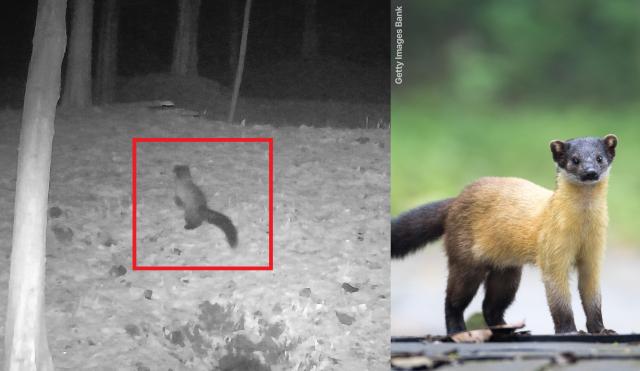
The company said Feb. 25 that a research team led by Prof. Park Byeong-gwon of the Korea Institute of Urban Ecology recently confirmed the presence of a marten, a Class II endangered wild species in South Korea, in Mir Forest.
The animal captured was a yellow-throated marten, a carnivorous mammal regarded as a top predator. Its presence indicates the lower food chain is also being maintained in a stable way, the company said.
Hyundai Mobis said the finding also reflects progress in its biodiversity work around the Miho River in Jincheon, suggesting the local ecosystem is recovering. Last year, the company said it confirmed habitats for an otter, a natural monument and endangered species, and a leopard cat, a legally protected species.
Mir Forest is a 108-hectare (about 267-acre) woodland created near Hyundai Mobis’ Jincheon plant, a production base dedicated to automotive electronic components. The company said it invested about 10 billion won over 10 years starting in 2012 to build the forest.
After donating the forest to Jincheon County, Hyundai Mobis said it has been running a social contribution project since 2023 with the local government and the social cooperative Hangang to help create a biodiversity ecosystem in and around the forest and the Miho River.
The company said it is also encouraging participation by employees and local residents, beyond providing funding for restoration efforts.
Han Seong-hui, executive director and head of Hyundai Mobis’ sustainability management office, said the company will work to create social value by not only cutting carbon emissions across its production process and making eco-friendly products, but also by considering the environmental characteristics of communities where its major sites are located.
* This article has been translated by AI.
Copyright ⓒ Aju Press All rights reserved.