

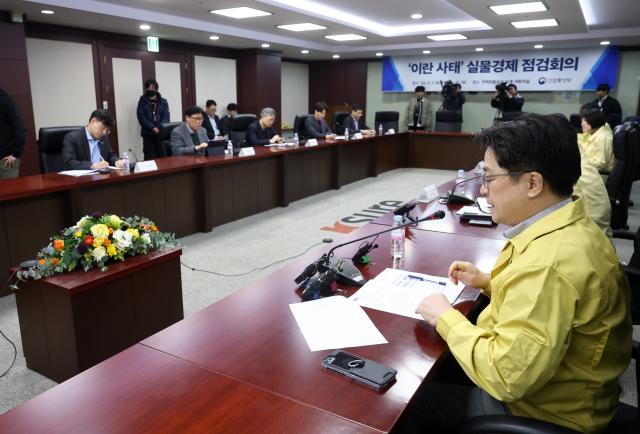
Given the country’s heavy dependence on imported energy and maritime trade routes, even a limited disruption in the Gulf region could ripple quickly through oil markets, shipping costs and industrial production.
Vice Industry Minister Moon Shin-hak convened an emergency meeting Sunday with officials from the foreign, climate, oceans and finance ministries, along with state-run energy firms and major business groups. The session reviewed vulnerabilities across energy supply, trade, logistics, financial markets and sector-specific exposures.
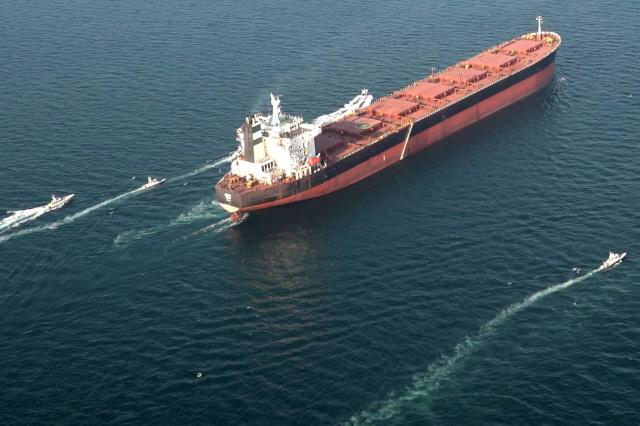
The immediate concern is the Strait of Hormuz — the narrow artery through which roughly 27 percent of global seaborne oil trade passes.
Korea imports 70.7 percent of its crude oil and 20.4 percent of its liquefied natural gas (LNG) from the Middle East. Any prolonged disruption would directly hit refining margins, petrochemical feedstock costs and electricity generation.
Officials said Korea holds several months’ worth of strategic oil reserves and maintains gas inventories above mandatory levels, providing short-term cushioning capacity. If private-sector crude stocks fall below a critical threshold, the Ministry of Trade, Industry and Energy plans to release reserves stored at nine strategic bases nationwide, including Yeosu and Geoje.
But contingency planning now includes more severe scenarios.
Global investment banks such as JPMorgan have warned that a full-scale closure of the Strait of Hormuz, coupled with broader military escalation, could push Brent crude toward $120–130 per barrel — nearly double the $64 baseline assumed in the Bank of Korea’s latest economic outlook.
The Bank of Korea last month projected 2.0 percent GDP growth and 2.2 percent inflation for 2026, premised on stable oil prices near $64 per barrel. Those forecasts did not factor in the current escalation.
A sustained oil spike would quickly erode Korea’s terms of trade, raise production costs across manufacturing and compress household real incomes through higher gasoline and utility prices.
Energy-intensive industries would feel the strain first. Refiners could see short-term inventory gains, but petrochemicals, steelmakers and airlines would likely face margin compression. LNG-dependent power generators would encounter higher fuel procurement costs, complicating electricity pricing and public utility finances.
The Korea International Trade Association (KITA) held a separate emergency logistics meeting Sunday to review contingency routes in case of Hormuz disruption.
While many container carriers have already been bypassing the Suez Canal via the Cape of Good Hope since the Red Sea disruptions in late 2023, crude and LNG tankers remain heavily exposed to Gulf transit routes.
If shipping lanes are rerouted via Omani ports such as Salalah or Duqm, freight rates could surge by 50 to 80 percent, with transit times extended by three to five days. War-risk insurance premiums have historically risen as much as sevenfold during regional crises — costs that would feed directly into export prices.
Direct export exposure to Gulf states remains relatively small. The seven countries bordering the Strait of Hormuz account for just 1.9 percent of Korea’s total exports, or $13.68 billion.
But indirect effects through higher energy prices and freight costs are far more consequential.
According to KITA estimates, a 10 percent rise in global oil prices increases Korea’s export unit prices by 2.09 percent but reduces export volumes by 2.48 percent, resulting in a net 0.39 percent decline in export value.
In an economy where exports account for roughly 40 percent of GDP, that dynamic carries significant macroeconomic weight.
The government has pledged liquidity support for affected exporters and expanded logistics vouchers to offset freight cost spikes. Authorities are also reviewing the possible deployment of temporary vessels should maritime congestion intensify.
So far, supply-chain vulnerabilities beyond oil and gas appear limited. Only a handful of chemical inputs — including bromine used in flame retardants and ethylene glycol for synthetic fibers — rely heavily on Middle Eastern sourcing. Officials say domestic production expansion and supplier diversification are underway.
Still, the broader macroeconomic risk is unmistakable.
Korea’s 2 percent growth outlook rests heavily on a semiconductor rebound and export recovery. A sustained oil shock could offset that tailwind by squeezing corporate margins and dampening consumer spending simultaneously.
For now, Seoul’s strategy is defensive: manage reserves, stabilize logistics and prevent excessive pass-through of oil prices into consumer inflation. Vice Minister Moon emphasized that authorities would “thoroughly manage” the transmission of global oil volatility into domestic fuel and gas prices.
If escalation remains contained, the damage may prove manageable. But should tensions intensify, Korea’s 2026 growth narrative may hinge less on semiconductor momentum and more on the price of a barrel of oil — and the safety of a narrow shipping lane thousands of miles away.
Copyright ⓒ Aju Press All rights reserved.
