

South Korea’s shift into a super-aged society is pushing “senior health care” — spanning medical services, caregiving, housing and nutrition — to the center of a fast-changing industry. Domestic pharmaceutical and biotech companies are moving beyond drug development, expanding into housing and artificial intelligence-based digital care as they seek new growth in an aging era.
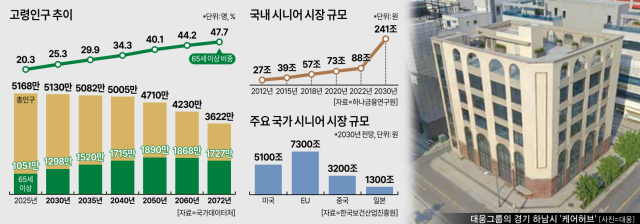
According to the National Data Portal on March 2, people 65 and older accounted for 20.3% of the population as of 2025, marking the country’s entry into a super-aged society. The government projects the share will reach 30% in 2036 and exceed 40% in 2050.
As the senior population grows, the market is increasingly viewed less as welfare and more as a high-value business. In particular, pharma and biotech companies are combining their drug-development capabilities with data and facility planning to build models that manage seniors across the full span of later life.

Daewoong Group will open a senior-only “Care Hub” in Hanam, Gyeonggi Province, in April. The complex, about 3,800 square meters (1,150 pyeong), is designed to continuously monitor seniors’ health by combining data and AI. Unlike traditional nursing facilities focused on care and treatment, it emphasizes disease prevention and extending healthy life expectancy. The company plans to link clinical and disease data it has accumulated with wearable devices and AI analysis to provide preventive, preemptive services. The hub will offer outpatient-style programs and stays of up to three months for intensive management.
Cha Bio Group is focusing on combining housing and medical services. Its affiliate Cha Healthcare last year partnered with POSCO E&C to develop senior residences, aiming to make living spaces function as medical platforms and narrow the gap between hospital and home.
AI-based senior platforms are also emerging. HLB Global, through its subsidiary HLB Lifecare, operates a platform that predicts and manages chronic diseases. Using data from Yonsei University medical institutions and AI, it forecasts the onset of conditions such as diabetes complications and provides highly personalized management. Last year it formed an “AI medical health care council” with Japan’s largest private equity fund manager, ACA, and Korean AI firms including Selvas AI, JLK, VUNO and Mediana, stepping up efforts to enter the Japanese market.
Senior nursing, housing and management services are widely seen as areas that can generate long-term cash flow. Hana Financial Research Institute projects South Korea’s senior market will expand to 241 trillion won by 2030 from 88 trillion won in 2022, an average annual growth rate of 13.4%.
Kim Dae-jong, a professor in the business administration department at Sejong University, said the senior industry is poised for rapid growth as longer life expectancy makes healthy longevity a shared goal. He added that pharmaceutical companies’ performance in related noncore businesses is also likely to rise.
* This article has been translated by AI.
Copyright ⓒ Aju Press All rights reserved.