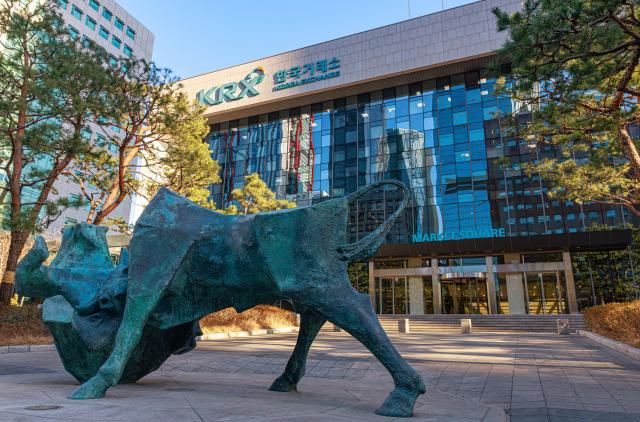
SEOUL, Mar 05 (AJP) - The South Korean "Value-up Index", a specialized stock market benchmark launched by the Korea Exchange (KRX) as a centerpiece of the government-led corporate value-up program, reached an all-time high last month.
The index was buoyed by a wave of share buybacks, cancellations, and enhanced shareholder return policies, alongside improving earnings across sectors including semiconductors, industrials, and finance.
According to the "Monthly Corporate Value Enhancement Status" report released by the Korea Exchange (KRX) on Thursday, five new companies filed value-up disclosures in February.
They were SeAH Steel Holdings from the KOSPI, and four Kosdaq-listed firms; Gold & S, Seoul Electronics & Telecom, JYP Entertainment, and i-SENS.
While the initiative was initially led by large-cap KOSPI stocks, the trend is increasingly spreading to the Kosdaq market. To date, a total of 181 companies have filed value-up plans, comprising 132 from the KOSPI and 49 from the Kosdaq.
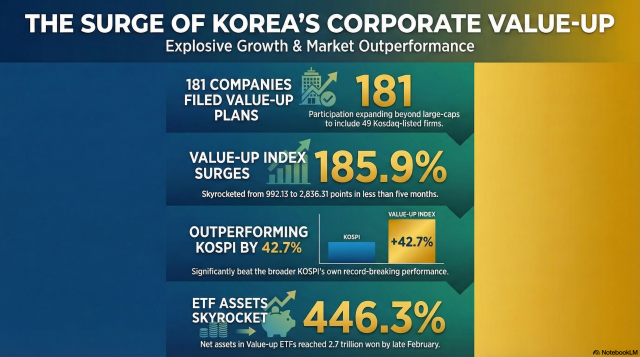
On Feb. 26, the Value-up Index peaked at 2,836.31 points, representing a 185.9 percent surge since its inception on Sept. 30, 2024 (992.13 points). During the same period, the index’s performance outpaced the KOSPI—which also hit a record high of 6,307.27 points—by a margin of 42.7 percentage points.
Capital has been flooding into Value-up related Exchange Traded Funds (ETFs). As of late February, the net assets of 13 listed Value-up ETFs reached 2.7 trillion won, a staggering 446.3 percent increase since their initial launch on Nov. 4, 2024.
Both indices suffered sharp declines recently following the U.S. invasion of Iran and the blockade of the Strait of Hormuz.
The KOSPI, which stood at the 6,300 level on Monday, plummeted by nearly 1,200 points (20 percent) over Tuesday and Wednesday, before rebounding 9.6 percent on Thursday to close at 5,583.90.
The Value-up Index similarly dropped by over 500 points from Feb. 27 through Wednesday, before gaining 225 points (9.7 percent) on Thursday to finish at 2,532.38.
Corporate efforts to enhance valuation are becoming increasingly tangible. Eleven firms, including JB Financial Group, Woori Financial Group, Meritz Financial Group, and INNOX Advanced Materials, have filed progress reports at least once a year since their initial disclosures.
Meritz Financial Group, for one, has disclosed its progress eight times, providing quarterly updates since its first filing last July.
Shareholder return policies are also expanding. Last month, KB Financial Group decided to buy back and cancel 600 billion won worth of its own shares.
DB Insurance and Meritz Financial Group also announced plans to cancel shares worth 800 billion won and 700 billion won, respectively.
The number of companies providing English-language disclosures for foreign investors has also been on the rise, increasing steadily from 74 in November last year to 82 last month.
Under the revision of the Enforcement Decree of the Restriction of Special Taxation Act, which went into effect this February, high-dividend companies must file corporate value enhancement plans to satisfy tax incentive requirements.
"We plan to support these companies through briefing sessions and one-on-one consulting to ensure smooth disclosure filings." the KRX stated.
Copyright ⓒ Aju Press All rights reserved.