

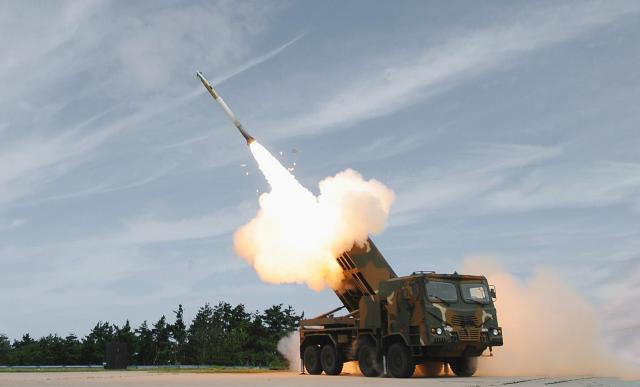
According to the defense industry on March 12, Hanwha took part in a defense exhibition opening that day in Brussels, Belgium, promoting systems including the long-range surface-to-air missile, or L-SAM, and the Chunmoo multiple rocket launcher. L-SAM is designed to intercept ballistic missiles at high altitude and is often described as a “Korean-style THAAD.” Chunmoo is a weapons system capable of firing various guided munitions.
By joining the exhibition in Belgium, home to NATO headquarters, Hanwha aims to accelerate its push into Western Europe. Hanwha Aerospace has secured contracts to supply Romania with K9 self-propelled howitzers and K10 armored ammunition resupply vehicles worth $1 billion, and to supply Poland with Chunmoo multiple rocket launchers in deals valued at $3.6 billion for the first phase and $2.2 billion for the second. Lim Kyung-wook, head of Hanwha Aerospace’s Romania unit, said at an international security and defense conference in Bucharest on March 10 (local time) that the company would expand in Europe based on a local factory.
The sales push comes as demand for South Korean air defense weapons grows quickly in Europe and the Middle East. Cheongung-II, deployed earlier this month in the United Arab Emirates, has drawn attention for its performance, spreading by word of mouth to neighboring countries. Industry observers have also suggested announcements of additional purchase agreements with multiple Middle Eastern countries could be imminent.
As production demand increases, South Korean defense firms are expanding their footprints. Hanwha Aerospace began construction last month on a production plant in Romania aimed at broadening its European supply chain.
In South Korea, affiliate Hanwha Systems relocated its Gumi production plant last year, increasing output capacity by about 30%. The facility expanded from 45,000 square meters to 89,000 square meters, roughly doubling in size. LIG Nex1, the lead contractor for South Korea’s missile systems, completed a guided-missile assembly and inspection facility this month in Gumi, North Gyeongsang Province, for the Fleet-to-Air Guided Missile-II. Korea Aerospace Industries said it built a second hangar near its Sacheon plant in South Gyeongsang Province in line with planned KF-21 deliveries in the second half of this year.
“Production lines tied to export contracts are already running at full capacity,” a defense industry official said. “If additional new weapons exports are secured, expanding the workforce will be unavoidable.”
Industry officials say shifting security conditions in Europe and the Middle East are creating opportunities for South Korean defense companies. As countries in those regions seek to reduce reliance on U.S.-made weapons and strengthen their own defense industries, analysts say South Korea has emerged as a niche supplier.
Choi Ki-il, a professor of military studies at Sangji University, said Europe’s expanding “buy European” approach is changing defense exports from simple weapons sales to deals that also build production facilities. For Middle Eastern countries, he said, difficulties importing weapons from adversary states are combining with a growing tendency to seek South Korea, which he described as having strong ground-weapons production capabilities among NATO countries.
* This article has been translated by AI.
Copyright ⓒ Aju Press All rights reserved.