

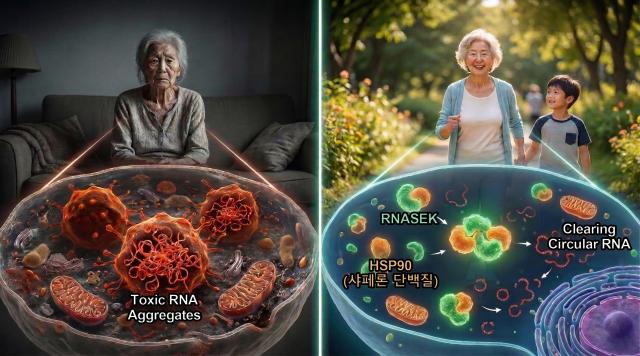
SEOUL, March 18 (AJP) - South Korean scientists have discovered that clearing molecular debris from cells can significantly slow the aging process and extend lifespan. Researchers at the Korea Advanced Institute of Science and Technology (KAIST) announced on March 18, 2026, that they identified a specific protein responsible for removing genetic waste that typically builds up as organisms get older.
The study focuses on circular RNA, a type of molecule that essentially acts as cellular trash. Unlike other genetic materials that the body recycles easily, these circular strands are highly resistant to being broken down. As a result, they clutter the cell over time and interfere with normal biological functions.
The research team found that a protein called RNASEK serves as a primary cleaning crew for this waste. By studying roundworms, mice, and human cells, the scientists observed that levels of this protein naturally drop with age. This decline allows circular RNA to pile up and form toxic clumps known as stress granules.
When the researchers artificially increased RNASEK levels, the test subjects lived significantly longer and remained in a healthier state. The protein works alongside other helper molecules to prevent genetic waste from sticking together and damaging the cell. These results remained consistent across different species, including mammals.
"Until now, circular RNA was largely seen as just a byproduct or an indicator of getting older," said Professor Lee Seung-jae. "This research proves that the accumulation of circular RNA actually drives the aging process, and that the RNASEK protein is a vital regulator that can slow this down to promote a healthy lifespan."
The project was a collaborative effort involving Professor Lee Seung-jae, Professor Kim Yun-ki, and Professor Lee Kwang-rok. The study included contributions from lead researchers Kim Si-eun, Ham Seok-jin, Bu Seong-ho, and Lee Dong-hun. The findings were published in the scientific journal Molecular Cell on February 24, 2026.
(Reference Information)
Journal/Source: Molecular Cell
Title: Ribonuclease κ promotes longevity by preventing age-associated accumulation of circular RNA in stress granules
Link/DOI: https://doi.org/10.1016/j.molcel.2026.01.031

Copyright ⓒ Aju Press All rights reserved.
