While the wider market reeled, KAI climbed.
The stock extended its recent rally, gaining for a second straight session and closing at 188,000 won, up 1.6 percent on the day — a stark contrast to the KOSPI’s 3 percent slide. The divergence underscores how defense names are increasingly trading as geopolitical proxies rather than cyclical industrial plays.
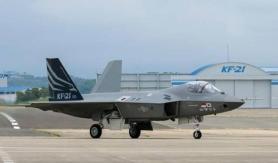
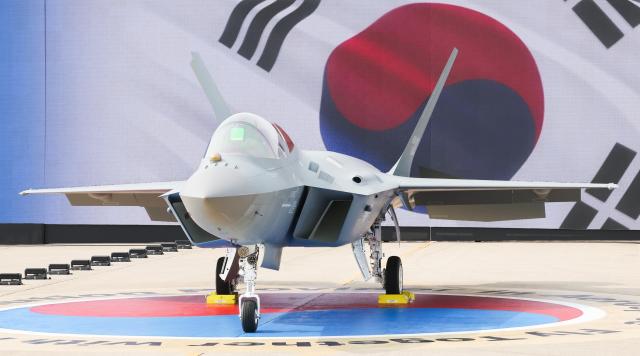
At the center of the momentum is the KF-21 Boramae — South Korea’s first indigenous fighter jet and a flagship outcome of the KF-X (Korea Fighter eXperimental) program led by KAI in collaboration with the Air Force and the Agency for Defense Development.
The program, backed by 7.48 trillion won ($5 billion) in investment and involving some 64,500 researchers and engineers, is now transitioning from development to mass production, with 120 aircraft scheduled for deployment by 2032 — a shift that marks the beginning of a long-cycle revenue stream.
But the real upside lies beyond Korea.
The KF-21 is gaining traction across a widening arc of potential buyers. Indonesia has already joined as a development partner, while the United Arab Emirates, Saudi Arabia, the Philippines and Poland have all expressed interest, according to government and industry sources.
The UAE, in particular, has emerged as a pivotal node. A $15 billion comprehensive defense cooperation framework agreed last November includes discussions on procurement, joint production and technology transfer — pointing to a deeper strategic alignment rather than a one-off sale. Saudi Arabia is also weighing the KF-21 as part of its broader air force modernization push.
South Korea’s entry into the club of advanced fighter jet producers — now the eighth globally to field a 4.5-generation or higher supersonic fighter, alongside the United States, China, Russia, Japan, France, Sweden and a European consortium — is beginning to translate into market value.
Analysts see the inflection point approaching.
“The KF-21 will become a core pillar of KAI’s earnings as mass production ramps up,” said Chae Un-saem of Hana Securities. “From here, the duration of the upcycle will increasingly depend on export execution.”
Brokerages are also turning more constructive on the broader defense sector, viewing the current geopolitical environment as a structural tailwind rather than a temporary spike.
Yuanta Securities maintained its “overweight” call, noting that “the KF-21 is not just a development milestone — it anchors a long-duration growth story spanning production, exports and next-generation capabilities such as manned-unmanned teaming.”

Copyright ⓒ Aju Press All rights reserved.