

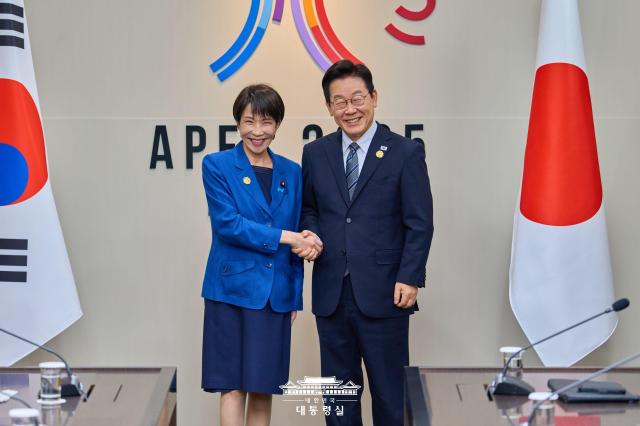
SEOUL, April 02 (AJP) -President Lee Jae Myung’s drum duet with Japanese Prime Minister Sanae Takaichi during his January visit to Tokyo was more than a light cultural moment. It captured, in miniature, a broader shift: two uneasy neighbors moving — cautiously but unmistakably — back into rhythm.
Lee himself framed the stakes with unusual clarity, warning that the global trade order is “unstable like never before” and calling deeper bilateral ties “an urgent task of our time.”
That urgency is no exaggeration. The strategic environment surrounding the Korean Peninsula has deteriorated sharply. War in Ukraine has tightened alignment among North Korea, China and Russia. The widening confrontation involving the United States, Israel and Iran has added a new layer of global volatility. What once looked like isolated flashpoints is increasingly converging into a more systemic rivalry.
Nowhere is that tension more concentrated than in the Indo-Pacific.
China’s growing assertiveness — from its installation of structures in the Yellow Sea to its sweeping export controls on critical materials — is no longer an abstract concern. It is already reshaping supply chains, testing economic resilience and signaling how coercion can be deployed below the threshold of conflict. For economies like South Korea and Japan, deeply embedded in global manufacturing networks, the implications are immediate and material.
The Taiwan Strait sits at the center of this strategic equation. Any disruption there would not simply be a regional security crisis; it would sever trade arteries that sustain both economies. That reality is driving Japan, backed by the United States, to expand deployments along its southwestern island chain — a move aimed at reinforcing deterrence before crisis becomes conflict.
For Seoul, geography leaves little room for strategic ambiguity. It faces not only the Taiwan contingency but also a nuclear-armed North Korea. The logic of closer coordination with Tokyo — once politically fraught — is becoming operationally unavoidable.
That shift is already visible. The real-time trilateral missile data-sharing system launched in late 2023, along with joint exercises such as Freedom Edge, marks a transition from symbolic cooperation to integrated defense readiness. Maintaining frameworks like GSOMIA is no longer a diplomatic choice but a functional necessity, combining South Korea’s proximity with Japan’s surveillance reach.
What makes this moment notable is not just the scale of external threats, but the contrast with the recent past. Only a few years ago, historical disputes pushed Seoul–Tokyo ties to the brink, spilling into trade retaliation and security friction. Today, those same two countries are rebuilding cooperation under far less forgiving conditions.
The broader strategic vision underpinning this rapprochement — the “Free and Open Indo-Pacific” — is often framed in abstract terms. But recent crises have made its stakes tangible. Disruptions in the Strait of Hormuz have already shown how quickly energy markets and global capital flows can be destabilized. In an interconnected system, security and economics are inseparable.
Japan now openly acknowledges that it faces its most severe security environment since World War II. South Korea, confronting parallel pressures, is arriving at a similar conclusion.
The drumbeat, then, is not just ceremonial. It reflects a deeper alignment driven less by sentiment than by necessity.
History still matters. Domestic politics still constrains. But the strategic calculus is shifting faster than either.
For Seoul and Tokyo, staying in step is no longer optional. It is the baseline for navigating an Indo-Pacific that is becoming more contested, more interconnected — and far less forgiving of hesitation.
![[이병종 숙명여대 글로벌서비스학부 교수]](https://image.ajunews.com/content/image/2024/10/02/20241002130529793020.jpg)
*The author is a professor in the Global Service Department at Sookmyung Women’s University
Author’s background
▷Ph.D. in journalism and communication, Yonsei University ▷AP correspondent ▷Newsweek Korea bureau chief ▷President, Seoul Foreign Correspondents’ Club
▷Ph.D. in journalism and communication, Yonsei University ▷AP correspondent ▷Newsweek Korea bureau chief ▷President, Seoul Foreign Correspondents’ Club
Copyright ⓒ Aju Press All rights reserved.
