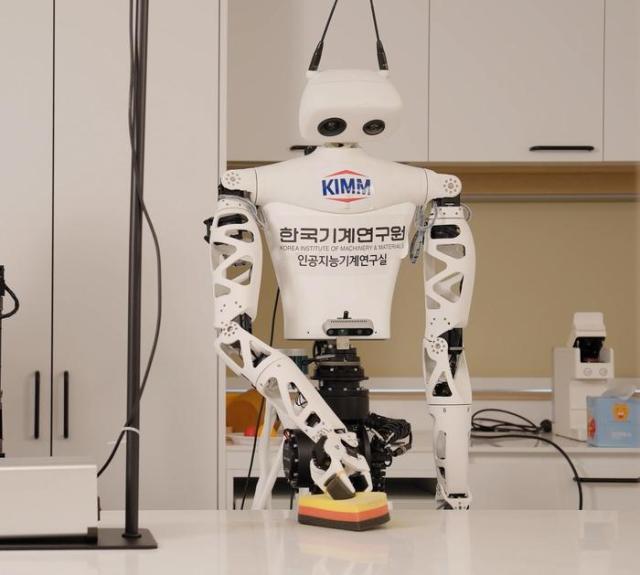
In its 122nd policy report uploaded Wednesday, KIMM said the industry has entered a "commercial tipping point" — the moment where humanoids shed their laboratory origins and begin generating revenue on factory floors and in service settings.
The pivot is underpinned by a sharp decline in manufacturing costs.
Per-unit expenses currently hover at about $35,000 but are expected to fall to between $13,000 and $17,000 within five years as mass production scales up and component designs mature.
China's Unitree Robotics has led the price collapse, driving its flagship model from $90,000 for the H1 in 2024 down to $5,900 for the R1 in 2025 — a trajectory KIMM attributes to Wright's Law, under which unit costs drop 15 to 20 percent each time cumulative output doubles.
Shipment volumes are poised to follow a similar exponential curve.
Bank of America projects global humanoid deliveries will surge from a cumulative 18,000 units in 2025 to about one million annually by 2030 to 2035. Goldman Sachs forecasts sales climbing from roughly 8,000 units in 2025 to 136,000 in 2030 and 2.1 million in 2035, entering what the bank calls a J-shaped acceleration phase.
The United States leads the race with big-tech-driven AI foundation models and semiconductor design advantages spearheaded by Tesla, Nvidia and Figure AI. China, meanwhile, has mobilized more than 140 companies into mass-production competition, with Chinese firms accounting for about 70 percent of newly unveiled humanoid models in 2025 and rapidly consolidating market share through vertically integrated supply chains and state subsidies.
South Korea possesses world-class semiconductor, battery and telecommunications infrastructure but remains hobbled by a shortage of indigenous AI foundation models and a fragile supply chain for humanoid-specific components such as actuators and reducers, the report said.
To close the gap, KIMM prescribed a "two-track" strategy: the first track calls for localizing core hardware — precision actuators, control systems and dedicated batteries — by leveraging the country's existing manufacturing base.
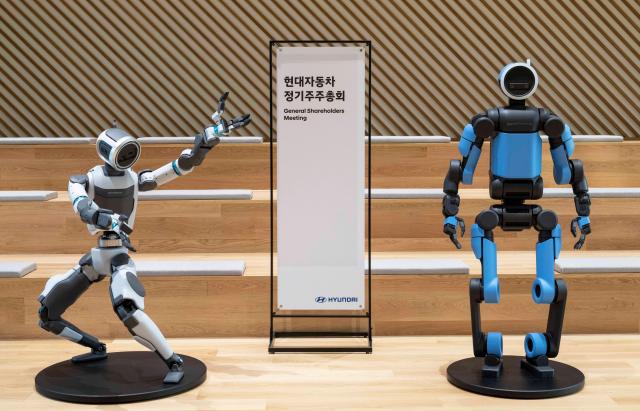
KIMM itself is spearheading a 220.8 billion won ($149.8 million) national project to develop a mass-production-ready humanoid platform, a self-learning AI brain and an open data factory where industry and academia can jointly train robot models. The institute plans to unveil the first version of its own humanoid, KAIROS, by April 2027.
"The era of flashy tech demos is over — what matters now is how quickly a robot can earn its keep on a real factory floor," said Kim Hee-tae, a senior researcher at KIMM's center of R&D policy.
"The window through 2030 is the golden time that will determine who commands this market, and Korea must convert its manufacturing edge into robotics leadership before that door closes."

Copyright ⓒ Aju Press All rights reserved.