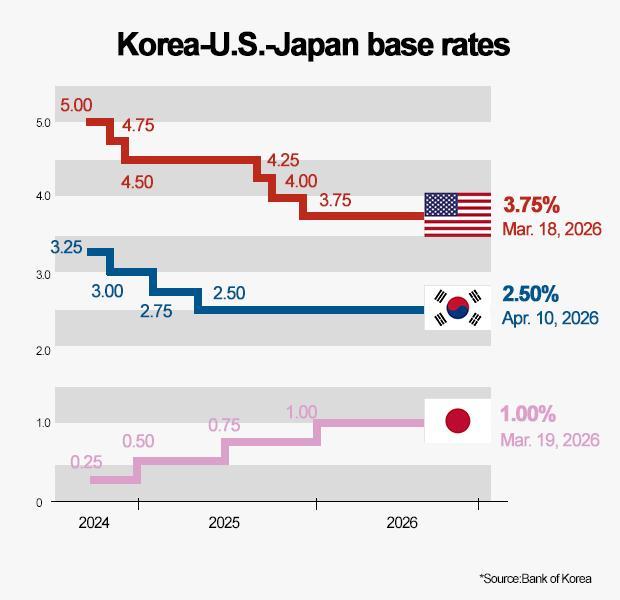
SEOUL, April 10 (AJP) — The Bank of Korea (BOK) unanimously held the base rate steady at 2.5 percent, opting for what it called “strategic patience” as the Black Swan shock from the Middle East conflict exerts both upward and downward pressure.
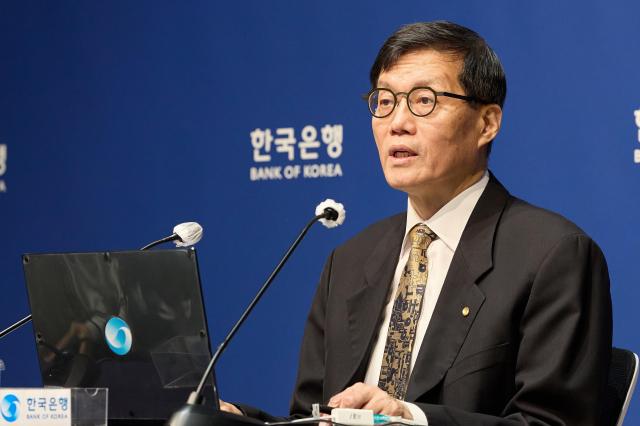
“The freeze at 2.5 percent is not a simple suspension,” Governor Rhee Chang-yong said Friday after presiding over his final monetary policy meeting before his term ends later this month. “Given the severity of the external factors, we need to examine the repercussions more thoroughly to judge our move accordingly.”
Admitting the limits of monetary policy in responding to highly volatile, war-driven variables, Rhee said the central bank has little choice but to “learn” from how the conflict unfolds — its spillover effects and duration — before making its next move.
The benchmark rate has remained unchanged since the last cut in May 2025.
The post-meeting Monetary Board statement nonetheless tilted hawkish, signaling more room for a hike than a cut as import-driven inflationary pressure builds. The BOK expects economic growth to fall short of its 2.0 percent target this year, while inflation could “substantially” exceed the 2.2 percent forecast depending on the trajectory of the war and oil prices.
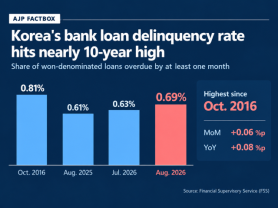
While projecting inflation could approach 3 percent, the board said it would steer policy to contain price pressures “within the target range” without destabilizing financial conditions — a nod to the risks posed by elevated private-sector debt.
The BOK’s stance mirrors a broader global shift. IMF Managing Director Kristalina Georgieva warned that global growth is set to slow further, with a full recovery to pre-crisis levels unlikely. The U.S. economy has already shown signs of cooling, with fourth-quarter growth revised down to 0.5 percent.
With less than ten days left in Rhee’s term and his message largely unchanged, markets remained steady. The won traded at 1,482.5 per dollar, little changed from the previous session. The three-year government bond yield stood at 3.360 percent and the 10-year yield at 3.686 percent, both moving within a 3 basis-point range.
Hold to verify variables, not to evade
While acknowledging still-subdued domestic demand, Rhee dismissed concerns that the economy is sliding into stagflation — at least for now.
“Since March consumer inflation was at a defensible level of 2.2 percent, it is difficult to speculate at this stage.”
The BOK will release an updated economic outlook at its May 28 policy meeting, incorporating the evolving Middle East situation and the impact of a supplementary budget.
On the foreign exchange market, Rhee said the drivers of the won’s weakness have shifted.
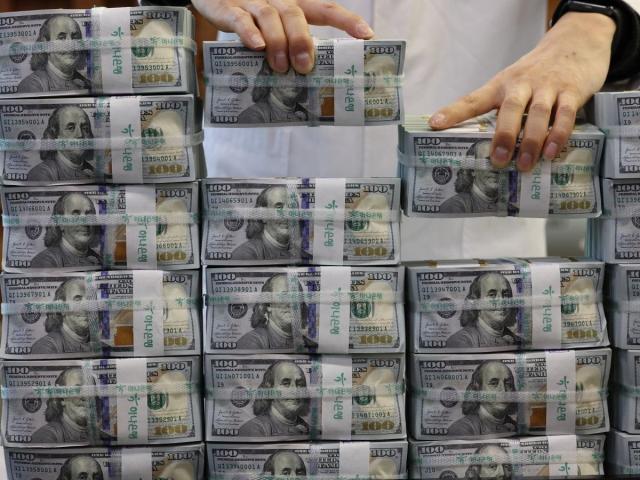
“While the rise in the exchange rate in the second half of last year was largely due to increased overseas investment by individuals, recent trends are driven primarily by foreign equity selling.”
Foreign investors sold a net $29.8 billion in March alone, bringing total outflows this year to $47.8 billion, according to the BOK. Rhee noted that Korea’s market structure — which allows quick profit-taking and capital withdrawal — remains a key source of volatility.
He also pointed to a distortion in dollar funding markets, where participants prefer lending dollars but are reluctant to repay them, despite ample current account surplus and spot liquidity.
On intervention, Rhee emphasized that foreign reserves should be used to smooth short-term volatility rather than influence long-term direction.
“In a phase where foreigners are realizing profits, strengthening the won could result in a structure where only foreign investors profit more,” he said, adding that the BOK has grown more cautious following large external shocks such as the Hormuz blockade.
He rejected structural interpretations of the won’s weakness — such as low growth or demographics — arguing that global dollar strength and liquidity conditions remain the dominant drivers.
Rhee also struck an optimistic note on Korea’s inclusion in the FTSE World Government Bond Index (WGBI), saying inflows from long-term institutional investors would help stabilize markets. Since the inclusion, about $4.6 billion in active bond funds and $1.1 billion in passive funds have flowed in, with passive allocations expected to provide durable support.
Swan-song warnings
In a parting critique, Rhee took aim at what he described as inefficient fiscal spending, including 4.8 trillion won allocated to local education.
“It is difficult to see it as efficient in the current situation,” he said, calling for more flexible execution suited to what he described as a “war-time supplementary budget.”
He also warned of renewed divergence in the property market.
“While high-priced housing in areas like Gangnam is in a downward phase, outlying districts in the Seoul metropolitan area are rising again,” he said.
“This can hardly be called market stability. If the return on housing assets continuously exceeds other assets, polarization is bound to deepen.”
Rhee concluded on a reflective note, saying he had maintained balance during his tenure despite criticism from both sides.
“I received criticism for being both ‘too late’ and ‘too early’ in cutting and raising rates,” he said. “I am looking forward to my future endeavors.”
Copyright ⓒ Aju Press All rights reserved.