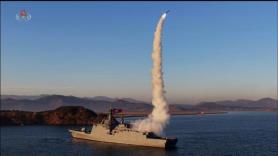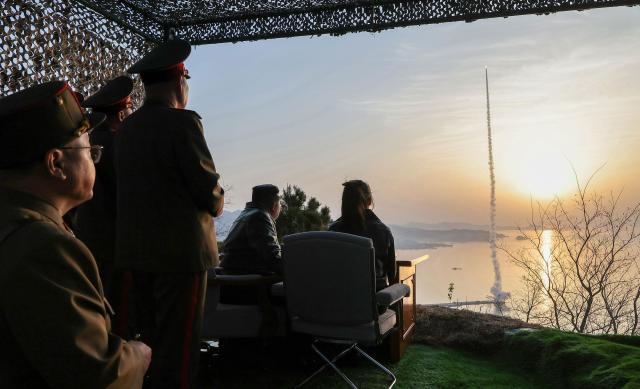
According to the state-run [North] Korean Central News Agency, the test was conducted the previous day to "evaluate the power of warhead of the improved surface-to-surface tactical ballistic missile Hwasongpho-11 Ra."
"Five tactical ballistic missiles, launched towards the target area around an island about 136 km away, struck the area of 12.5~13 hectares with the very high density, fully displaying their combat might," KCNA said.
The purpose of the test was to "verify the characteristics and power of cluster bomb warhead and fragmentation mine warhead applied to the tactical ballistic missile," it added.
The country's leader Kim Jong-un, accompanied by his daughter Ju-ae, expressed "great satisfaction" over the test, touting that the development of different cluster bomb warheads would "boost the high-density striking capability to quell a specific target area as well as the high-precision striking capability."
He also encouraged defense and military officials to "continuously make successes in the important undertakings to acquire and update various ultra-modern technologies necessary for the combat preparedness of our army."
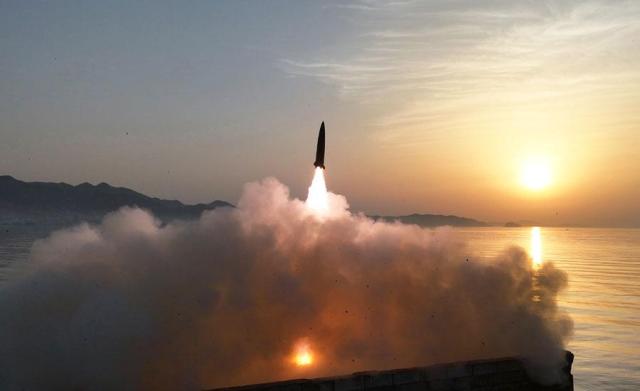
But this time, they appeared to carry cluster-munition and fragmentation-mine warheads, both designed to maximize damage by dispersing submunitions or metal fragments across a large area.
A day earlier, South Korea's military said it detected multiple short-range ballistic missiles launched from Sinpo in South Hamgyong Province toward the East Sea at around 6:10 a.m. and they flew approximately 140 kilometers.
"The simultaneous launch of five missiles striking 12.5 to 13 hectares demonstrated the ability to hit a wide area beyond simple precision strikes," said Lim Eul-chul, a professor at Kyungnam University's Institute for Far Eastern Studies. "It was also unusual to gather all key commanders responsible for border areas with South Korea in one place, suggesting the tested weapon will be deployed to frontline units."
Copyright ⓒ Aju Press All rights reserved.