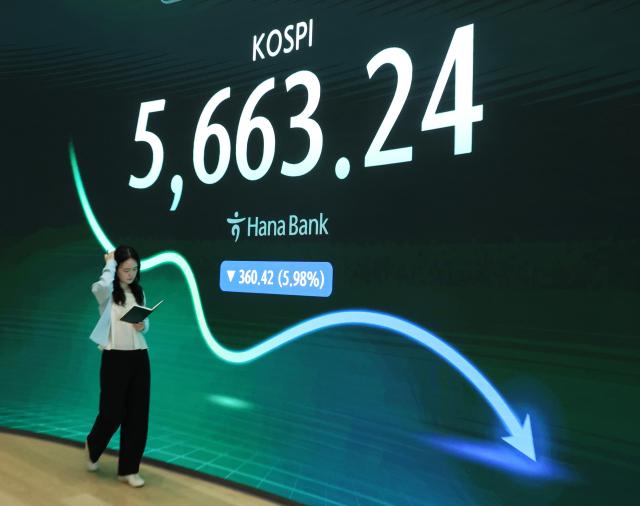
The benchmark KOSPI closed 5.98 percent lower at 5,663.24, while the tech-heavy KOSDAQ fell 6.12 percent to 662.68 after both indexes recovered from intraday losses of more than 10 percent.
Earlier in the session, both markets triggered 20-minute circuit breakers as heavy selling swept through the bourse, just a day after the KOSPI suffered its steepest decline in nearly five months. What began as a semiconductor-led correction quickly snowballed into a broader unwinding of South Korea's AI-driven rally.
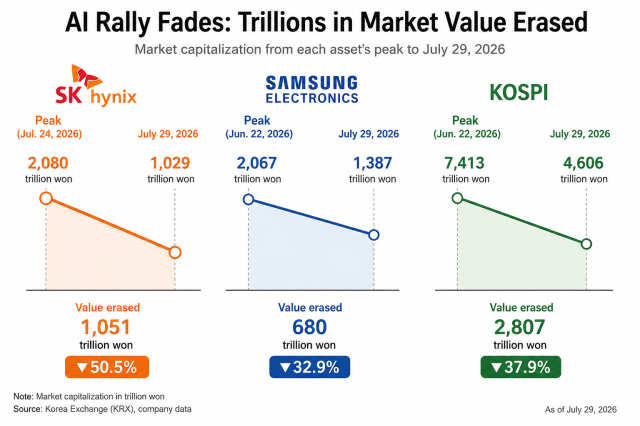
The rout erased about 2,807 trillion won ($2 trillion) in market value from KOSPI-listed companies, exposing how heavily the rally had depended on just two AI champions.
SK hynix has lost about 1,051 trillion won in market value since its recent peak, shrinking from roughly 2,080 trillion won to 1,029 trillion won, a decline of 50.5 percent. Samsung Electronics has shed about 680 trillion won, falling from approximately 2,067 trillion won to 1,387 trillion won, down 32.9 percent.
The combined market capitalization of KOSPI-listed companies has dropped from about 7,413 trillion won at its recent peak to roughly 4,606 trillion won, erasing nearly 38 percent of market value, according to Korea Exchange data.
At the rally's peak, Samsung Electronics and SK hynix together accounted for more than 40 percent of the KOSPI's weighting, helping propel the benchmark to repeated record highs. As sentiment toward the two chipmakers reversed, the broader market quickly followed.
Record profits no longer enough
SK hynix became the immediate catalyst after reporting record second-quarter earnings that nevertheless fell short of investors' elevated expectations.
The world's second-largest memory chipmaker posted record quarterly revenue of 79.21 trillion won and operating profit of 60.54 trillion won for the April-June period, driven by robust demand for high-bandwidth memory chips used in AI accelerators. Its operating margin reached an all-time high of 76.1 percent.
Yet even record earnings failed to satisfy investors, reinforcing concerns that exceptional profits were no longer enough to justify AI-driven valuations.
During its earnings call, SK hynix reiterated that AI infrastructure investment by hyperscale cloud providers would remain strong beyond next year, said it had secured long-term supply agreements with about 10 major customers and unveiled plans to invest nearly 50 trillion won this year to expand production capacity.
Rather than reassuring investors, the outlook raised fresh questions over whether hyperscale spending could continue expanding fast enough to justify another wave of memory-industry capacity investment. The lack of more concrete shareholder-return measures added to the disappointment.
SK hynix shares plunged 18.8 percent to 1,258,000 won, while SK Square, whose value is closely tied to its stake in the chipmaker, tumbled 12.0 percent to 403,500 won. Samsung Electronics reversed an early gain to finish 8.0 percent lower at 277,500 won, while Samsung Electro-Mechanics dropped 11.2 percent to 121,000 won.
Selling quickly spread beyond semiconductors. Hyundai Motor fell 7.0 percent to 284,500 won, LG Energy Solution lost 7.1 percent to 345,000 won, Samsung Biologics declined 5.3 percent to 1,148,000 won, KB Financial Group slid 8.4 percent to 112,000 won, Samsung Life Insurance dropped 7.4 percent to 136,800 won and Shinhan Financial Group fell 6.4 percent to 69,000 won.
Foreign investors started the session as net buyers but turned into sellers as losses accelerated. Individuals also sold shares, while institutional investors absorbed part of the pressure through net purchases, including flows believed to be linked to exchange-traded funds.
Concerns had already been building before the earnings release. Investors were reassessing the enormous capital spending required to sustain the AI infrastructure boom, questioning whether hyperscale investment would generate sufficient returns and whether memory-chip earnings were approaching a cyclical peak.
China's rapid semiconductor advances added another layer of concern. The blockbuster Shanghai debut of memory maker ChangXin Memory Technologies, together with reports of progress in domestic chipmaking equipment, reinforced fears that China's memory industry was narrowing the technology gap with global leaders.
At the same time, expectations of further Bank of Japan rate hikes revived fears of another yen carry-trade unwind. Higher Japanese yields and a stronger yen reduced the appeal of financing overseas investments with cheap yen borrowings, prompting investors to trim leveraged positions across Asian equities, particularly AI-related trades that had attracted heavy foreign inflows.
The weakness spread across the region. Japan's Nikkei 225 fell 1.49 percent to close at 61,434.19 as Kioxia Holdings and chip-equipment maker Kokusai Electric tumbled, while Taiwan's benchmark dropped 3.76 percent to 40,039.18.
Leverage accelerated the sell-off
The market's structure magnified the decline.
Retail investors had piled into single-stock leveraged ETFs during the rally, using products designed to deliver twice the daily return of Samsung Electronics and SK hynix. As the shares plunged, those leveraged bets quickly unraveled, triggering another wave of forced selling.
Margin calls on investors who had borrowed to buy semiconductor shares and leveraged ETFs further accelerated the decline.
Trading in inverse products linked to individual chipmakers also surged as investors rushed to profit from the downturn. Because leveraged and inverse ETFs rebalance their portfolios daily, sharp one-way moves can generate additional buying or selling in the underlying shares, reinforcing volatility.
The collateral damage was equally severe. As the market crumbled, panic spread among retail investors. Online stock forums were flooded with desperate posts such as, "Please save me. I'll never invest in stocks again," "I was a fool for believing SK hynix would reach 5 million won," and "How much further can it fall? My hands are shaking."
Kim Yong-beom, the presidential chief policy secretary, said single-stock leveraged ETFs should not bear sole responsibility for the market's volatility. Speaking during President Lee Jae Myung's visit to Brazil, he argued that South Korea's market structure—not just leveraged products—had amplified the swings.
He cited the heavy weighting of Samsung Electronics and SK hynix in the benchmark index, the dominance of active retail investors and the widespread use of derivatives as structural factors magnifying market moves.
"A 10-point move at the center of the market can easily become a 20- or 30-point move in Korea because of the characteristics of our market," he said.
The Financial Services Commission has already suspended new listings of such products and will raise the minimum cash requirement for new or additional investments from 10 million won to 30 million won. Even so, Wednesday's sell-off suggested that positions accumulated during the AI rally remained large enough to destabilize the broader market.
On the KOSDAQ, individuals were net sellers while foreign and institutional investors were net buyers. Biotechnology heavyweight Alteogen fell 7.3 percent, battery materials maker EcoPro BM dropped 8.9 percent and its parent EcoPro lost 8.2 percent. Robotics developer Rainbow Robotics slid 9.1 percent, semiconductor equipment makers Jusung Engineering and Wonik IPS fell 10.4 percent and 9.6 percent, respectively, while precision-parts supplier Rino Industrial declined 7.5 percent. Drug developer HLB also dropped 6.8 percent. PharmaResearch, a medical aesthetics company, bucked the broader market by rising 3.2 percent.
By the close, few corners of the market had been spared.

Copyright ⓒ Aju Press All rights reserved.