The remarks marked Lee’s clearest attempt yet to draw a line between joining a war and contributing to maritime security as Seoul faces sustained U.S. pressure over Hormuz.
“There will be no deployment that involves or intervenes in war,” Lee said during a press conference at Cheong Wa Dae. “We will not make such a troop deployment or dispatch military assets.”
Lee said the principle of noninvolvement would remain unchanged but added that South Korea still needed to conduct a “minimum level of activities” to protect its merchant ships, crude oil transportation routes and citizens, as other countries do.
He specifically pointed to the Cheonghae Unit, South Korea’s long-running anti-piracy naval contingent, saying Seoul was reviewing ways to strengthen its role in responding to threats to ships and Korean nationals.
But Lee rejected sending forces or military assets in a way that would involve South Korea in the fighting.
“To make it clear once again, there will be no deployment to the war,” Lee said.
Lee’s comments came after weeks of government preparations to examine what a potential South Korean contribution could look like.
A government assessment team made up of defense and foreign ministry officials traveled to the United Arab Emirates earlier this month and returned on Sept. 10 after examining military facilities and ports that could support South Korean assets, as well as maintenance, logistics and operational conditions.
The UAE, which lies near the Strait of Hormuz, hosts Al Dhafra Air Base, one of the main U.S. military facilities in the region and a possible operating location for P-8A Poseidon maritime patrol aircraft. The Defense Ministry has stressed that the assessment mission was intended to review local conditions and the security environment and did not presuppose a deployment.
“If we operate under U.S. command and control, that means participating in the war,” said Paik Seung-hoon, a senior researcher at the Institute of Middle East Studies at Hankuk University of Foreign Studies, adding that the most important dividing line was who controlled the mission and what its purpose was.
“But if we retain our own operational control, as we did in 2020, and define the mission as protecting our civilian merchant vessels, that is something we can do.”
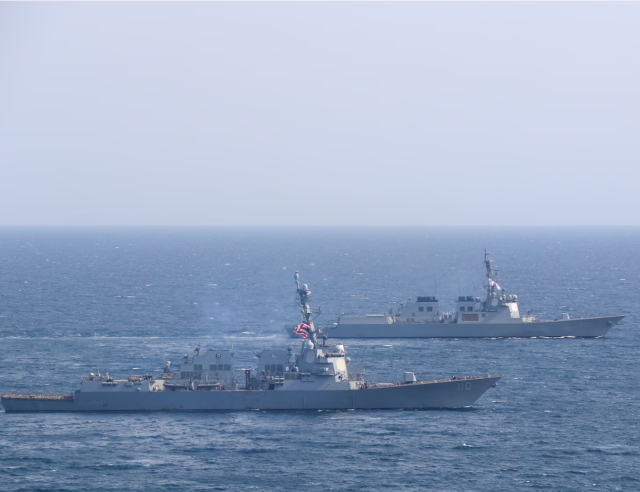
South Korea expanded the operating area of the Cheonghae Unit in 2020, originally deployed for anti-piracy operations in the Gulf of Aden, so it could protect South Korean merchant vessels amid heightened tensions in the region. The unit remained under South Korean command rather than operating as part of a U.S.-led force.
Paik said, however, that an independent mission under current wartime conditions would require a much larger force than South Korea currently has deployed in the region.
“If we want to conduct an independent operation, we would need at least around 10 vessels,” he said, explaining that South Korea would have to provide its own command and control, surveillance and defensive capabilities against threats ranging from anti-ship rockets and drones to fast attack boats and mines.
That would not mean deploying 10 Aegis destroyers, Paik said, but assembling a broader naval formation that could include destroyers, mine-countermeasure assets and potentially submarines.
One or two South Korean vessels could operate with far fewer supporting assets if integrated into U.S. intelligence and command networks — a scenario Paik said would blur the line between maritime protection and participation in the war.
Lee on Friday appeared to leave open the possibility of reinforcing the existing Cheonghae mission without crossing that line.
“We are reviewing and carefully considering ways to strengthen that role,” Lee said.
Unlike the war in Ukraine, where South Korea has sought to manage relations with both Kyiv and Moscow, the conflict with Iran directly involves the United States, South Korea’s treaty ally, said Kim Hong-yoo, a professor at Kyung Hee University and a policy committee member at the Korea Defense Industry Association.
“This is a war involving our ally because the United States itself is directly fighting,” Kim said. “If an ally is under attack and the other ally simply stands aside, it raises the question of what the alliance means.”
Japan faces a similar calculation as Washington presses allies to do more to help secure the Strait of Hormuz.
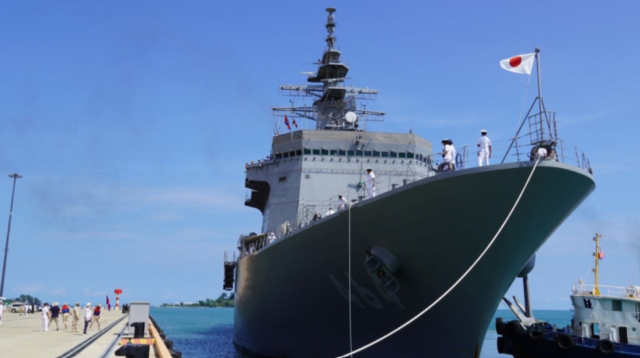
Japan has particular expertise in the area. The Maritime Self-Defense Force sent minesweepers to the Persian Gulf after the 1991 Gulf War. Under Japan’s existing legal framework, however, minesweeping during active hostilities could amount to combat activity, making a ceasefire a critical condition for such a mission.
Hosaka Yuji, a specially appointed professor at Korea University specializing in international politics and Korea-Japan relations, said Prime Minister Sanae Takaichi has favored a more active security role alongside the United States but faces domestic and legal constraints on a direct deployment.
Hosaka said mine-clearing would be one of Japan’s most realistic options once the fighting stopped.
“If there is a ceasefire, Japan can move quickly to send the Self-Defense Forces to the Strait of Hormuz,” Hosaka told AJP in an earlier interview, pointing in particular to Japan’s mine-clearing capabilities.
Foreign Minister Toshimitsu Motegi said in March that minesweeping could be considered if a ceasefire were reached and mines continued to obstruct navigation. Takaichi has likewise said any dispatch would depend on conditions at the time and Japanese law.
South Korean Foreign Minister Cho Hyun is due to meet U.S. Secretary of State Marco Rubio in Washington on Friday local time, with cooperation over the Strait of Hormuz expected to be among the issues on the agenda.
Lee has now defined what South Korea will not do. The harder question is how far Seoul can expand a maritime-protection mission without allowing command, intelligence and operational requirements to turn that mission into participation in the war — a line Tokyo, too, is having to navigate.
AJP Takeaways
- President Lee Jae Myung ruled out South Korean military involvement in the Iran war, drawing a clear line against troop or military asset deployments tied to combat.
- Seoul is still considering limited maritime measures around the Strait of Hormuz, including strengthening the Cheonghae Unit to protect Korean vessels, citizens and energy routes.
- South Korea faces continued U.S. pressure over Hormuz, raising questions over how far Seoul can support its treaty ally without becoming directly involved in the conflict.
- Japan is another key variable in the regional response, with Tokyo considering post-ceasefire mine-clearing while remaining constrained from joining active hostilities.

Copyright ⓒ Aju Press All rights reserved.