

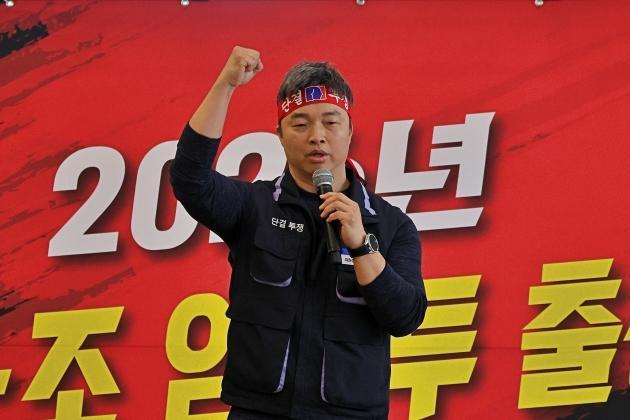
The Korea Finance Union has launched this year’s industrywide bargaining, raising its demands for higher pay and shorter working hours. With June local elections approaching and politicians courting labor support, analysts say the union’s voice is growing louder.
According to the financial sector on April 21, the union recently held its “2026 first delegation bargaining session” and began full talks with the Financial Industry Employers Association. Its key demands include an 8.0% increase in total wages, adoption of a 4.5-day workweek, raising the retirement age to 65 while scrapping the wage-peak system, and blocking relocation of headquarters outside the capital area. The two sides plan to hold main bargaining talks on May 27.
For its 2026 wage proposal, the union is seeking an 8.0% increase in total wages — about 2.5 times last year’s agreed raise of 3.1%. The union said the figure reflects projected economic growth of 2.0% and consumer inflation of 2.2%, as well as a 3.8% decline in real wages over the past five years.
A 4.5-day workweek without pay cuts is also a central issue. The union says it will not accept reductions tied to shorter hours, while management argues some adjustment is needed, leaving the issue unresolved.
Yoon Seok-gu, the union’s chairman, said, “It’s time for workers to receive fair compensation,” adding, “Just as spring does not come on its own, our rights must be won through a fierce struggle.”
In and outside the industry, some see the election calendar as strengthening the union’s bargaining position. The union has about 100,000 members, including workers at major commercial and state-run banks, and has drawn political attention during election seasons. The article noted that the union formed a policy alliance with the Democratic Party during last year’s presidential election, fueling expectations that the ruling camp will find it difficult to ignore labor demands.
The union’s standing has also been bolstered by recent political messages urging labor to take a more active role. President Lee Jae-myung told a labor event to “fight hard for workers’ rights,” and Democratic Party leader Jung Cheong-rae said, “Make more noise at worksites,” according to the article.
Still, the union’s demands may struggle to win broad public support. Average annual pay for employees at the four major banks — KB Kookmin, Shinhan, Hana and Woori — was 122.75 million won last year, up 4.03% or 4.75 million won from 118.00 million won a year earlier. By contrast, the average total pay for regular workers last year was 50.61 million won, less than half the level for bank employees.
A financial industry official said the union has in recent years proposed high wage increases and shorter hours and, if management refuses, moved toward strikes. “This year as well, the domestic and external business environment is not good, so difficult labor-management talks are expected,” the official said.
* This article has been translated by AI.
Copyright ⓒ Aju Press All rights reserved.