

Companies selected for the Science and ICT Ministry’s push to build an independent AI foundation model are expanding cooperation with Nvidia, accelerating efforts to broaden South Korea’s AI ecosystem. The partnerships aim to combine data, infrastructure and models to strengthen industry-specific AI competitiveness.
LG AI Research said that on the 21st, co-head Lim Woo-hyung and EXAONE Lab head Lee Jin-sik met with Nvidia Vice President of Applied Research Brian Catanzaro and Nvidia Korea CEO Jung So-young at LG’s Magok office in Seoul to discuss next-generation AI model development and joint ecosystem-building strategies.
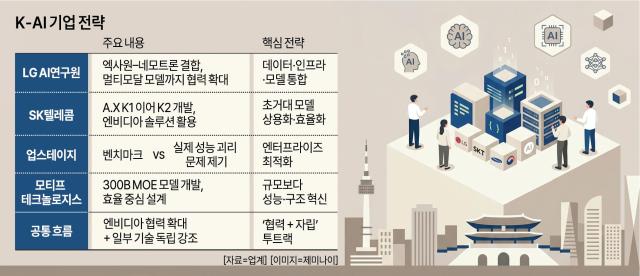
The two sides agreed to widen cooperation by linking LG’s EXAONE with Nvidia’s Nemotron open ecosystem to jointly develop specialized models for professional fields. Building on collaboration from EXAONE 3.0 through the recently released multimodal model 4.5, they plan to increase integration across data, infrastructure and software.
LG AI Research said it has improved training quality using Nemotron datasets, while Nvidia has supported training optimization and inference efficiency through its latest graphics processing units and tools such as the NeMo framework.
LG AI Research said the results are reflected in Stanford University’s Institute for Human-Centered Artificial Intelligence “AI Index Report.” It said South Korea ranked third among countries with notable AI models, and that four of the five models cited were from the EXAONE series.
Telecom companies are also expanding cooperation. SK Telecom disclosed results of its AI model development work with Nvidia at “Nvidia Nemotron Developer Days Seoul 2026.”
SK Telecom said it plans to use Nvidia solutions in developing “A.X K2,” a follow-up to “A.X K1,” which it introduced under the independent foundation model project. The company previously applied Nemotron datasets and related frameworks during training of A.X K1, a model with 519 billion parameters, to secure stability for large-scale distributed training. The two companies are holding technical consultations every two weeks to discuss infrastructure stability, performance improvements and optimization measures.
In a panel discussion co-hosted by the ministry and Nvidia on the 21st, participating companies outlined shared priorities. Elice Group emphasized the need for “vertical AI” optimized for specific industries such as manufacturing and finance. Upstage said a key task is narrowing the gap between benchmark performance and real-world enterprise deployment.
SK Telecom said it is focusing beyond early “performance verification” on commercialization suitable for real services and on improving inference efficiency. Motif Technologies said it is developing a 300B Mixture-of-Experts model and aims to narrow the gap with global big tech through efficiency-focused design rather than a race for scale alone.
Still, concerns were raised about overreliance on an Nvidia-centered ecosystem. Motif CEO Lim Jeong-hwan said that when freedom to experiment with model architectures is critical, heavier dependence on Nvidia software could constrain independent innovation.
* This article has been translated by AI.
Copyright ⓒ Aju Press All rights reserved.