

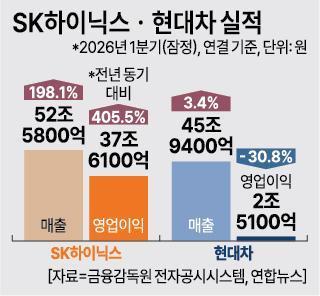
SK hynix posted its best quarterly results on record on surging demand for artificial intelligence chips, while Hyundai Motor saw profitability weaken despite higher sales, raising fresh concerns about Korea’s growing reliance on semiconductors.
On the 23rd, SK hynix said first-quarter revenue rose to 52.5763 trillion won and operating profit to 37.6103 trillion won. That was up 198.1% and 405.5% from a year earlier, respectively, and marked a record for any quarter. Its operating margin reached 72%, the company said.
The results were unusual for a seasonally slow period, helped by expanding AI infrastructure investment and a shift toward higher-value products. The boom could continue as AI demand broadens from training to real-time inference, strengthening the base for memory demand. Some in the securities industry have forecast SK hynix’s annual operating profit could exceed 200 trillion won, which would place it fourth globally.
Hyundai Motor and Kia, however, showed weaker profitability even as sales grew. Hyundai Motor’s first-quarter revenue rose 3.4% from a year earlier to 45.9389 trillion won, but operating profit fell 30.8% to 2.5147 trillion won. Kia, which is set to report on the 24th, is expected to post operating profit of 2.2986 trillion won, down about 24%, according to the consensus estimate cited in the report.
The two automakers posted record sales in the U.S. market, but tariff costs weighed heavily on earnings, the report said. Hyundai Motor said it spent 860 billion won on tariff costs in the first quarter. Kia’s tariff costs are estimated at 500 billion to 700 billion won.
Other headwinds included higher oil prices tied to the Middle East war, rising raw material prices and a weaker currency. The report said a fire at a parts supplier in Daejeon caused production disruptions of about 30,000 vehicles, while Middle East risks added pressure to both logistics costs and the sales environment.
With autos, a key export industry, also hit by worsening external conditions, the profit structure of Korean industry is becoming more concentrated in semiconductors, the report said. In an AI-driven industrial reshuffle, semiconductors have moved into an outsized-profit phase, while autos remain highly exposed to policy and cost variables, it added.
Kim Pil-su, a professor in the Department of Future Automotive Engineering at Daelim University, said reliance on Samsung Electronics and SK hynix for AI semiconductors such as high-bandwidth memory, or HBM, means the semiconductor tilt is likely to persist for now. He added that uncertainty over auto tariffs continues and geopolitical risks in the Middle East are growing.
* This article has been translated by AI.
Copyright ⓒ Aju Press All rights reserved.