

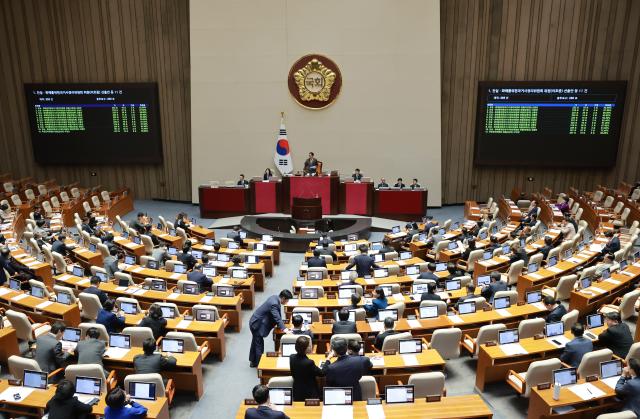
The National Assembly holds the seventh plenary session of its April extraordinary session on the 23rd. [Photo=Yonhap]
South Korea’s National Assembly on the 23rd passed a package of measures to strengthen protections for victims of rental fraud, including a legal basis to support tenants whose recovered deposits fall short of a minimum guaranteed amount.
Lawmakers approved revisions to the Act on Support for Victims of Rental Fraud and Housing Stability by unanimous consent of the 182 members present. Under the changes, if the amount a tenant recovers by exercising opposability rights or priority repayment rights does not reach the minimum guaranteed level, the shortfall can be supported.
The Assembly passed a total of 103 noncontroversial bills at the plenary session.
Among them was the bill on the establishment and operation of a National Graduate Medical School, creating a legal basis to set up a national institution to train personnel for public health and medical services. The bill requires graduates to serve in the public medical sector for 15 years after obtaining a medical license.
Ruling and opposition parties also revised the Equal Employment Opportunity and Work-Family Balance Assistance Act and the Employment Insurance Act to expand paid leave for infertility treatment to four days from the current two.
To prevent consumers from being misled by unfair advertising using artificial intelligence, lawmakers revised the Cosmetics Act, the Act on Labeling and Advertising of Foods, and the Pharmaceutical Affairs Act.
The plenary session also passed revisions to the Act on the Protection and Support of Small Business Owners to provide a basis for supporting closed small businesses, including management, legal and tax consulting. Another bill established a comprehensive management framework to foster the used-battery industry.
Other measures approved included revisions to the Narcotics Control Act to allow undercover or identity-concealed investigations into drug crimes; revisions to the law on exercising sovereign rights over foreign fishing in the exclusive economic zone to sharply raise fines for foreign vessels caught fishing illegally; and a bill on guaranteeing the rights of people with disabilities that spells out dignity and equality rights.
Lawmakers also passed revisions to the special act on establishing Sejong Special Self-Governing City, raising the share of proportional-representation seats in the city council to 14% from 10% relative to district seats.
The Assembly also completed the lineup for the third Truth and Reconciliation Commission, which investigates past incidents. Lee Ho-jung, a professor at Sogang University Law School recommended by the Democratic Party, and Jang Young-soo, an emeritus professor at Korea University Law School recommended by the People Power Party, were appointed as standing commissioners.
Nonstanding commissioners recommended by the Democratic Party were attorney Kim Young-joo of Law Firm Jihyang, activist Kim Jeong-ha of Disability and Human Rights Action Balbadak, and Jeong Won-ok, head of the Cultural and Social Research Institute. Those recommended by the People Power Party were attorney Kim Ung-gi of Sein Partners, Lee Dong-wook, a former member of the May 18 Democratization Movement Fact-Finding Commission, and attorney Choi Chang-ho of Jeongron. The Assembly also approved Lee Hyun-joo, head of the Park Jong-chul Center, recommended by National Assembly Speaker Woo Won-shik, and Park Rae-gun, a director at the Human Rights Foundation Saram, recommended by the Basic Income Party representing non-negotiating parties.
Including the 10 members elected on the 23rd, the commission will have 13 members: Chair Song Sang-gyo, standing commissioner Kim Gwi-ok and nonstanding commissioner Park Gu-byeong, all designated by President Lee Jae-myung, along with the newly selected members.
Lawmakers approved revisions to the Act on Support for Victims of Rental Fraud and Housing Stability by unanimous consent of the 182 members present. Under the changes, if the amount a tenant recovers by exercising opposability rights or priority repayment rights does not reach the minimum guaranteed level, the shortfall can be supported.
The Assembly passed a total of 103 noncontroversial bills at the plenary session.
Among them was the bill on the establishment and operation of a National Graduate Medical School, creating a legal basis to set up a national institution to train personnel for public health and medical services. The bill requires graduates to serve in the public medical sector for 15 years after obtaining a medical license.
Ruling and opposition parties also revised the Equal Employment Opportunity and Work-Family Balance Assistance Act and the Employment Insurance Act to expand paid leave for infertility treatment to four days from the current two.
To prevent consumers from being misled by unfair advertising using artificial intelligence, lawmakers revised the Cosmetics Act, the Act on Labeling and Advertising of Foods, and the Pharmaceutical Affairs Act.
The plenary session also passed revisions to the Act on the Protection and Support of Small Business Owners to provide a basis for supporting closed small businesses, including management, legal and tax consulting. Another bill established a comprehensive management framework to foster the used-battery industry.
Other measures approved included revisions to the Narcotics Control Act to allow undercover or identity-concealed investigations into drug crimes; revisions to the law on exercising sovereign rights over foreign fishing in the exclusive economic zone to sharply raise fines for foreign vessels caught fishing illegally; and a bill on guaranteeing the rights of people with disabilities that spells out dignity and equality rights.
Lawmakers also passed revisions to the special act on establishing Sejong Special Self-Governing City, raising the share of proportional-representation seats in the city council to 14% from 10% relative to district seats.
The Assembly also completed the lineup for the third Truth and Reconciliation Commission, which investigates past incidents. Lee Ho-jung, a professor at Sogang University Law School recommended by the Democratic Party, and Jang Young-soo, an emeritus professor at Korea University Law School recommended by the People Power Party, were appointed as standing commissioners.
Nonstanding commissioners recommended by the Democratic Party were attorney Kim Young-joo of Law Firm Jihyang, activist Kim Jeong-ha of Disability and Human Rights Action Balbadak, and Jeong Won-ok, head of the Cultural and Social Research Institute. Those recommended by the People Power Party were attorney Kim Ung-gi of Sein Partners, Lee Dong-wook, a former member of the May 18 Democratization Movement Fact-Finding Commission, and attorney Choi Chang-ho of Jeongron. The Assembly also approved Lee Hyun-joo, head of the Park Jong-chul Center, recommended by National Assembly Speaker Woo Won-shik, and Park Rae-gun, a director at the Human Rights Foundation Saram, recommended by the Basic Income Party representing non-negotiating parties.
Including the 10 members elected on the 23rd, the commission will have 13 members: Chair Song Sang-gyo, standing commissioner Kim Gwi-ok and nonstanding commissioner Park Gu-byeong, all designated by President Lee Jae-myung, along with the newly selected members.
* This article has been translated by AI.
Copyright ⓒ Aju Press All rights reserved.