

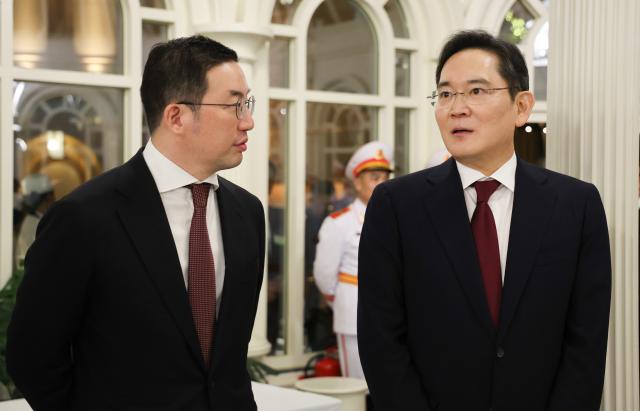
The forum, hosted by Lee and Vietnamese Prime Minister Le Minh Hung, was held April 23 (local time) at a hotel in Hanoi. It drew key officials from both governments, an economic delegation of 109 South Korean companies, and about 500 participants from public institutions and the private sector.
Attendees included Samsung Electronics Executive Chairman Lee Jae-yong; SK Group Chairman Chey Tae-won, who also heads the Korea Chamber of Commerce and Industry; LG Group Chairman Koo Kwang-mo; Lotte Group Chairman Shin Dong-bin; POSCO Holdings Chairman Chang In-hwa; HD Hyundai Vice Chairman Chung Ki-sun; GS Chairman Huh Tae-soo; Hyosung Chairman Cho Hyun-joon; Doosan Enerbility Chairman Park Ji-won; Daewoo Engineering & Construction Vice Chairman Jung Won-ju; Hyundai Motor Group President Sung Kim; and Naver CEO Choi Soo-yeon. Leaders of major business groups also attended, including Yoon Jin-sik of the Korea International Trade Association and Kim Ki-moon of the Korea Federation of SMEs.
Before a closed-door session, Lee Jae-yong told reporters that “businesspeople should speak through results.”
Koo said LG has operations in India and expressed hope that the trip would help business move forward. He noted that exchanges and corporate activity between South Korea and Vietnam are already extensive, adding that he hoped cooperation would advance “not only in quantity but also in quality.”
Park of Doosan Enerbility said Vietnam is seeking to build nuclear power plants and that he came prepared to introduce his company. He said he planned to focus on the company’s track record during the forum.
At the forum, Samsung Electronics, SK Innovation, the Korea Institute of Science and Technology and the Korea Institute for International Economic Policy discussed ways to upgrade an “industry, investment and science-and-technology partnership.” The talks focused on four areas: nurturing advanced talent, energy, AI transformation and science and technology.
On talent development, Na Ki-hong, head of Samsung Vietnam’s strategic cooperation office, introduced cases of manufacturing-innovation consulting and smart-factory support. He also outlined plans to expand “future technology education for youth” to cultivate next-generation talent.
Cooperation in AI transformation and energy infrastructure was also discussed. SK Innovation CEO Choo Hyung-wook stressed the importance of power infrastructure for building an AI ecosystem and shared a roadmap for ongoing cooperation projects, including the Quynh Lap LNG power project.
Science-and-technology cooperation to support future industries also drew attention. KIST President Oh Sang-rok presented a vision linking talent, technology and industry and proposed a strategy combining South Korea’s maturity with Vietnam’s dynamism. Vietnamese presenter Nguyen Trung Chinh, chairman of CMC, also shared strategies for innovation in advanced industries based on AI and science and technology, calling for stronger technology partnerships.
In opening remarks at a prior meeting, President Lee said economic cooperation between South Korea and Vietnam was increasingly important amid rising global uncertainty. He highlighted the need to strengthen supply-chain links in energy-related areas, including rare earths and urea solution, which are essential for advanced industries.
Lee said Vietnam needs efficient power distribution networks, including LNG power plants and nuclear power, to support a stable industrial environment. He urged the business leaders gathered to serve as a cornerstone for opening new horizons of cooperation.
In a speech, Lee again emphasized the need for closer economic ties, laying out visions for future advanced industries, supply-chain and energy cooperation, and science-and-technology collaboration.
“Because we have firm trust and friendship, South Korea and Vietnam can grow together without wavering in the face of any crisis and design the future,” Lee said. “Just as Vietnam’s leap was South Korea’s growth, Vietnam’s future will now be South Korea’s future.”
Citing a saying by Vietnam’s late leader Ho Chi Minh — “respond to all changes with what does not change” — Lee said the unchanging friendship built over more than 30 years is the surest answer to complex changes ahead. He pledged that the South Korean government would serve as a “reliable compass and support” so companies in both countries can navigate challenges and write a new era of prosperity.
The Korea Chamber of Commerce and Industry said 74 memorandums of understanding were signed at the forum between companies from the two countries in areas including advanced technology, consumer goods, infrastructure, energy and finance.
Key areas included AI data centers and digital infrastructure; energy such as nuclear power and power-grid construction; production bases for secondary batteries and advanced materials; smart cities and infrastructure development; and finance and investment.
SK Innovation and SK Telecom signed MOUs with Vietnam’s National Innovation Center on building an “AI data center and ecosystem,” and separately with Nghe An province on “AI infrastructure,” expanding cooperation on future infrastructure.
Daewoo Engineering & Construction also signed an MOU with Vietnam’s SaigonTel to jointly develop a data center project and participate in construction.
Cooperation on secondary batteries and advanced materials also advanced. POSCO Future M said it completed approval procedures with Thai Nguyen province to build a plant for artificial graphite anode material, a key secondary-battery material, and moved to build a supply chain.
In energy, cooperation drew on South Korea’s nuclear technology and experience building power grids. Doosan Enerbility signed agreements with Vietnamese companies PTSC and PETROCONs on cooperation related to new nuclear power plants in Vietnam. Taihan Cable & Solution signed an MOU with Vietnam’s Newtecons on upgrading power grids and cooperating on extra-high-voltage cable projects, aiming to expand technical partnerships for local energy infrastructure.
* This article has been translated by AI.
Copyright ⓒ Aju Press All rights reserved.