

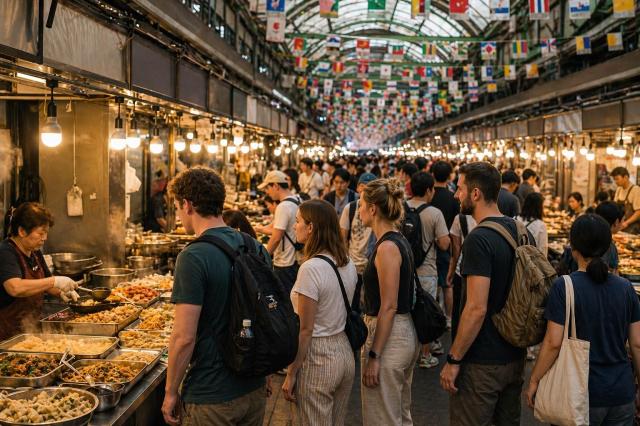
Traditional markets popular with foreign visitors are often a condensed view of South Korea — its food, people, atmosphere and prices. Against that backdrop, the overcharging dispute at Seoul’s Gwangjang Market has become more than a complaint about cost, raising questions about how the country is seen by tourists.
A Myanmar-born YouTuber who has lived in South Korea for 13 years recently said he visited Gwangjang Market with a Russian friend and was asked to pay 2,000 won for a bottle of water at a street stall. The vendor first replied, “Because there are a lot of foreigners,” then changed course after being told, “We’re Korean, too,” saying, “I sell it like that to Koreans, too.” The price — higher than at convenience stores — and the response drew criticism, especially since restaurants in South Korea do not commonly charge separately for water.
The issue has resurfaced repeatedly. Past controversies have included cases in which vendors raised the price of soondae without notice and demanded extra payment, and behavior that pressured customers who did not order more. Each time, explanations followed that it was “a deviation by some merchants,” but repeated incidents point to a structural problem and a broader loss of trust in the market.
With Gwangjang Market widely seen as a must-visit stop for foreign tourists, the impact can be amplified. Travel experiences are quickly shared on YouTube and social media and consumed as content. Videos by travel creators describing overcharging in places such as Egypt have helped spread negative impressions of entire countries, and South Korea is not immune. A single unpleasant encounter can overshadow positive experiences tied to K-culture, K-pop and K-dramas.
Government and local authorities have acknowledged the problem. The Ministry of SMEs and Startups, the Seoul Metropolitan Government and Jongno District have carried out joint inspections and provided merchant training and guidance when disputes flare. But the pattern has persisted: conditions improve briefly during crackdowns, then slide back. The problem, the column argues, is not the direction of policy but a lack of sustained enforcement.
The column calls for a more fundamental approach, including institutionalizing full price transparency by clearly posting all menu items and prices and requiring advance notice of any additional charges. It also urges mandatory multilingual guidance so foreign visitors can easily understand pricing.
It also calls for stronger self-policing led by merchant associations. While associations may have helped internal cohesion, the column says they have fallen short in protecting public trust. It argues that a system should allow meaningful penalties — including real limits on business operations — for merchants who repeatedly cause problems, describing such steps as a minimum safeguard to keep the market viable.
The column adds that merchants need to view traditional markets as a tourism asset. Inflating prices for short-term gain can lead to long-term losses, it says, because disappointed visitors do not return. By contrast, tourists who experience reasonable prices and warm service can become informal promoters. The priority, it argues, is not more sales but a better experience.
A market that loses trust will eventually be avoided, and the damage will fall on the many merchants who do business honestly. The Gwangjang Market dispute, the column concludes, is not a minor episode but a test of what path South Korea’s traditional markets will choose — and that basic fairness remains the strongest competitive advantage for bringing visitors back.
* This article has been translated by AI.
Copyright ⓒ Aju Press All rights reserved.