

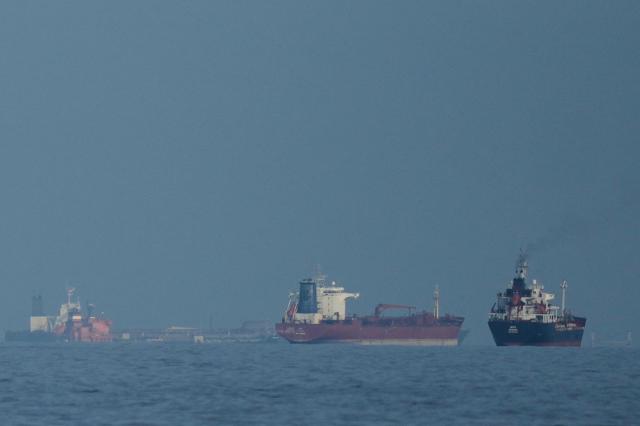
Reuters, citing TankerTrackers.com satellite-based data, reported April 27 that two tankers bound for Asia carrying roughly 4 million barrels of Iranian crude exited the strait on April 24. By contrast, six other tankers carrying a combined 10.5 million barrels were blocked in recent days and turned back, the data showed.
Four additional Iranian tankers returned empty from Asia and were last spotted near Pakistan’s coast.
Iran moved to control the Strait of Hormuz immediately after the war began on Feb. 28, and the United States began a maritime blockade against Iran on April 13. Iran briefly reopened the strait April 17-18 before resuming controls, and traffic has fallen sharply from the prewar daily average of 125 to 140 transits.
U.S. Central Command said April 25 that since the blockade began it has redirected 37 vessels to alternate routes. Reuters reported the U.S. military appears to have ordered some ships to turn back in the Gulf of Oman while allowing others to pass.
As of April 27, at least seven ships transited the strait over the previous day, according to ship-tracking firm Kpler and satellite analytics company SynMax, but none were tankers. Most were bulk carriers; some departed Iraqi ports and one sailed from an Iranian port.
Reuters said that because the U.S. military is rerouting Iran-linked ships as far as near the Strait of Malacca, it remains unclear whether the cargoes will reach buyers or be intercepted and sent back to Iran.
Reuters also reported that an Abu Dhabi National Oil Co. liquefied natural gas carrier appears to have successfully transited the Strait of Hormuz. If confirmed, it would be the first known case since the war began of an LNG-laden vessel passing through the strait. There had previously been a case of an Omani carrier transiting without LNG on board.
According to ICIS LNG Edge and MarineTraffic, the vessel was first detected in Gulf waters on March 30, then went dark for weeks before reappearing recently in waters west of India.
In Gulf waters, some ships have also switched off location signals or transmitted false information to avoid tracking.
* This article has been translated by AI.
Copyright ⓒ Aju Press All rights reserved.