

[Source: Rural Development Administration]
The Rural Development Administration said on the 28th it will expand production sites for new apple varieties to 59 hectares this year, up from 22 hectares last year. It also plans to raise the adoption rate of domestically developed apple varieties from about 24% to at least 35% by 2030.
About 69% of South Korea’s apple cultivation is concentrated in the Yeongnam region. With climate change pushing suitable growing areas northward, the agency said there is a growing need to spread production across regions and diversify varieties. New varieties, however, face hurdles because consumer awareness is low and many farms lack cultivation know-how, the agency noted.
To address that, the RDA is working with local governments and distributors to build specialized regional production complexes, including in Gunwi (the variety Golden Ball) and in Chungju and Pohang (the variety “Easyple”). The plan is to link production with distribution and sales to broaden the use of Korean-bred apple varieties.
Gunwi County is cultivating the yellow-skinned Golden Ball variety on 20 hectares, citing easier peel-color management. Chungju and Pohang have introduced Easyple on 15 hectares and 10 hectares, respectively, and are working to stabilize quality, the agency said.
The regional complexes are a joint framework involving growers, distributors and local governments. Growers can improve competitiveness by producing varieties suited to local conditions, while distributors can secure steady volumes and strengthen market response through joint shipments. Local governments expect higher farm income and greater regional recognition through specialized varieties.
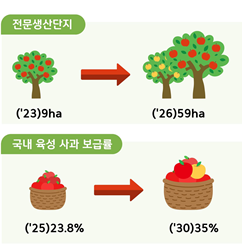
The RDA said it expanded the complexes from 9 hectares in 2023 to 22 hectares last year and is targeting 59 hectares this year. It plans to tie the effort to its smart orchard initiative, which includes flat canopy training, mechanization and information and communications technology-based disaster response. Based on that, the agency aims to lift the adoption rate of domestically developed apple varieties from 23.8% in 2025 to at least 35% in 2030.
Lee Dong-hyeok, head of the Apple Research Center at the RDA’s National Institute of Horticultural and Herbal Science, said the complexes are “a system that links production and distribution based on a growing environment that can maximize the traits of new varieties.” He added that they are expected to serve as hubs to expand the use of Korean varieties and strengthen the competitiveness of the apple industry.
About 69% of South Korea’s apple cultivation is concentrated in the Yeongnam region. With climate change pushing suitable growing areas northward, the agency said there is a growing need to spread production across regions and diversify varieties. New varieties, however, face hurdles because consumer awareness is low and many farms lack cultivation know-how, the agency noted.
To address that, the RDA is working with local governments and distributors to build specialized regional production complexes, including in Gunwi (the variety Golden Ball) and in Chungju and Pohang (the variety “Easyple”). The plan is to link production with distribution and sales to broaden the use of Korean-bred apple varieties.
Gunwi County is cultivating the yellow-skinned Golden Ball variety on 20 hectares, citing easier peel-color management. Chungju and Pohang have introduced Easyple on 15 hectares and 10 hectares, respectively, and are working to stabilize quality, the agency said.
The regional complexes are a joint framework involving growers, distributors and local governments. Growers can improve competitiveness by producing varieties suited to local conditions, while distributors can secure steady volumes and strengthen market response through joint shipments. Local governments expect higher farm income and greater regional recognition through specialized varieties.
The RDA said it expanded the complexes from 9 hectares in 2023 to 22 hectares last year and is targeting 59 hectares this year. It plans to tie the effort to its smart orchard initiative, which includes flat canopy training, mechanization and information and communications technology-based disaster response. Based on that, the agency aims to lift the adoption rate of domestically developed apple varieties from 23.8% in 2025 to at least 35% in 2030.
Lee Dong-hyeok, head of the Apple Research Center at the RDA’s National Institute of Horticultural and Herbal Science, said the complexes are “a system that links production and distribution based on a growing environment that can maximize the traits of new varieties.” He added that they are expected to serve as hubs to expand the use of Korean varieties and strengthen the competitiveness of the apple industry.
* This article has been translated by AI.
Copyright ⓒ Aju Press All rights reserved.