

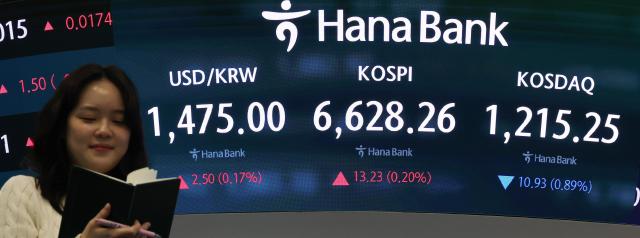
As of April 24, dollar deposits at South Korea’s five major banks — KB Kookmin, Shinhan, Hana, Woori and NH NongHyup — totaled about $64.118 billion, the financial sector said Monday. That was up $5.28532 billion, or 8.8%, from $59.272 billion at the end of March. Dollar deposits are foreign-currency accounts that convert won into dollars at the exchange rate at the time of deposit.
Balances have moved with the exchange rate. Deposits at the five banks surged from $56.33355 billion in October last year to $65.68157 billion in December as the average won-dollar rate climbed from 1,423 won in October to 1,467 won in December, reflecting stronger demand to buy dollars on expectations of further won weakness.
This year, deposits edged up from $65.667 billion at the end of January to $65.842 billion at the end of February as uncertainty persisted with the exchange rate fluctuating in the mid-1,400s.
But after the U.S.-Iran war broke out at the end of February and the exchange rate spiked, the trend reversed. Dollar deposits fell to $59.272 billion at the end of March, down about 10% from the previous month, as individuals and companies sold dollars amid a sustained high exchange rate. The won-dollar rate ended weekly trading in the 1,500s on March 19 for the first time in 17 years. The Bank of Korea said the average won-dollar rate in March was 1,486 won, close to 1,500.
Banks said the rebound this month reflects both a temporary pullback in the exchange rate and growing expectations that elevated levels could persist, prompting customers to buy dollars in advance. With swings widening, both households and companies have reacted quickly.
“Since the war, the exchange rate has moved in and out of the 1,500s, and there’s a sense that 1,470 to 1,480 won is a bargain-buying opportunity,” a commercial bank official said. “A pattern is forming where people sell when the rate rises and waiting demand comes in when it falls.”
Some analysts cautioned it is too early to view the rebound as a lasting shift, citing the risk of renewed volatility if the war drags on, including after a second ceasefire negotiation between the United States and Iran fell through.
“Since the start of the year, dollar deposit balances have moved very quickly depending on exchange-rate changes,” another commercial bank official said. “With uncertainty still high, volatility is likely to continue in the near term.”
* This article has been translated by AI.
Copyright ⓒ Aju Press All rights reserved.