

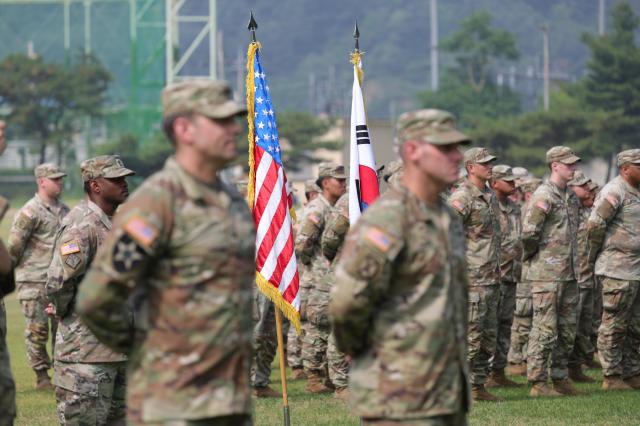
Seoul, however, is drawing a firm line against speculation.
South Korea’s Ministry of National Defense said Thursday that “no discussions whatsoever” have taken place with Washington regarding any reduction of U.S. Forces Korea (USFK), underscoring that the alliance’s core mission — maintaining a robust combined defense posture against North Korea — remains unchanged.
The reassurance came after U.S. President Donald Trump said via social media that Washington is reviewing a possible troop reduction in Germany, adding that a decision would be made “soon.”
While the comment was directed at Europe, its implications reverberated across alliance networks.
Concerns that troop deployments could be wielded as political leverage are not new. Trump has repeatedly pressed allies on burden-sharing, at one point overstating U.S. troop levels in South Korea while arguing Seoul had fallen short of supporting broader U.S. strategic priorities.
Yet the likelihood of an abrupt shift on the Korean Peninsula remains structurally constrained.
The National Defense Authorization Act for Fiscal Year 2026 includes provisions barring any reduction of USFK personnel below 28,500 without congressional approval — a legislative safeguard designed to prevent precisely such politically driven recalibration.
A parallel requirement to maintain at least 76,000 U.S. troops in Europe reinforces that, despite rhetorical pressure, alliance commitments retain institutional depth.
Still, the more consequential shift is unfolding beneath the surface.
U.S. Forces Korea is increasingly being repositioned not as a peninsula-bound deterrent, but as part of a broader Indo-Pacific operational framework emphasizing “strategic flexibility.”
“The U.S. is seeking to ensure that USFK is no longer tied exclusively to peninsular defense, but can be mobilized across the Taiwan Strait and the South China Sea,” said Jeong Kyung-woon of the Korean Military Studies Association.
This evolution is captured in the emerging concept of the “kill web,” highlighted by General Xavier Brunson, commander of the ROK-U.S. Combined Forces Command and USFK.
The framework envisions a fully networked battlespace linking sensors — from satellites and drones to ground-based radar — with strike capabilities across allied forces, enabling faster, more flexible responses across theaters.
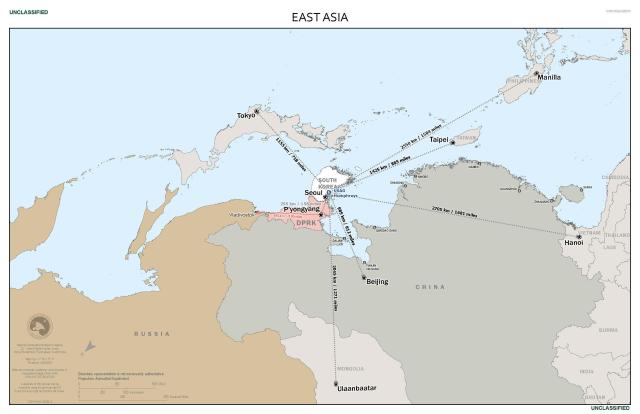
A threat detected in one domain could be processed and neutralized through assets deployed from another, effectively turning East Asia into an integrated operational space rather than a collection of discrete fronts.
Brunson underscored that U.S. allies in the region cannot operate in isolation. “When you connect them, adversaries no longer have a single axis to focus on, which strengthens overall military effectiveness,” he said.
This doctrinal shift coincides with ongoing negotiations over the transfer of wartime operational control (OPCON), with Washington signaling a possible timeline before early 2029 under the administrations of Lee Jae Myung and Trump.
For Seoul, the immediate risk of a drawdown may be limited. But the longer-term shift toward a more mobile, integrated and regionally oriented USFK presents a more complex strategic adjustment — one that extends well beyond the Korean Peninsula.

Copyright ⓒ Aju Press All rights reserved.
