

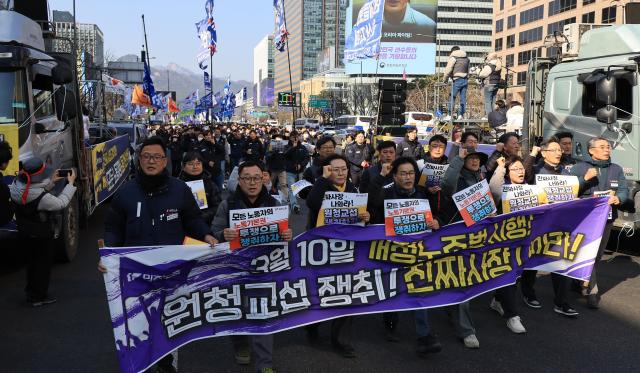
The Ministry of Employment and Labor reported the findings Thursday at an emergency economic headquarters meeting held jointly with a meeting of economy and external economy ministers, as part of its “response direction for major labor issues.”
As of April 27, 400 prime contractors had received bargaining demands: 223 in the private sector (56%) and 177 in the public sector (44%). Within the public sector, 11 central government bodies, 112 local governments, 46 public institutions and eight local public enterprises, including local government-owned firms, received demands.
In the public sector, 13 organizations posted public notices acknowledging the bargaining demands, including Busan Transportation Corp., Korea Asset Management Corp. and Hwaseong City; 11 of those issued final notices. In the care sector, a government-labor consultative body is operating to discuss substantive improvements in working conditions for care workers. Six public institutions participating in a “win-win bargaining” consulting program are working on selecting agenda items and reviewing key disputes.
Officials also discussed recently announced talks on improving treatment for subcontracted and nonregular workers in the public sector. The core measures include ensuring appropriate wages, narrowing pay gaps and strengthening job security. The plan also includes strengthening the prior review system and ensuring the sustainability of treatment improvements. The ministry asked relevant agencies to swiftly take necessary follow-up steps.
The first-term Economic, Social and Labor Council under the Lee Jae-myung government, launched April 19, will sequentially establish its individual panels. Eleven panels are to be formed, including those focused on responding to overlapping crises during the transition period such as artificial intelligence, and on structural improvements to the labor market.
The ministry also released its “foreign workforce integrated support roadmap 추진방향.” It calls for an integrated approach covering appropriate supply-and-demand management for all working foreign nationals, protection of labor conditions, industrial safety, and support for stay and return. The ministry said it will announce the roadmap by June after consultations with relevant agencies and will also pursue revisions to the Foreign Employment Act.
* This article has been translated by AI.
Copyright ⓒ Aju Press All rights reserved.