SEOUL, April 30 (AJP) — Decoupling across South Korean asset markets has intensified over the past two months of war in the Middle East, with equities extending a solo rally while the currency and bond markets remain under pressure.
With few safe havens in a wartime environment, equities have emerged as the primary risk asset. In contrast, the won and government bonds — more exposed to macroeconomic stress — have been weighed down by disruptions to the Strait of Hormuz and now, the uncertainty over the Federal Reserve’s policy path.
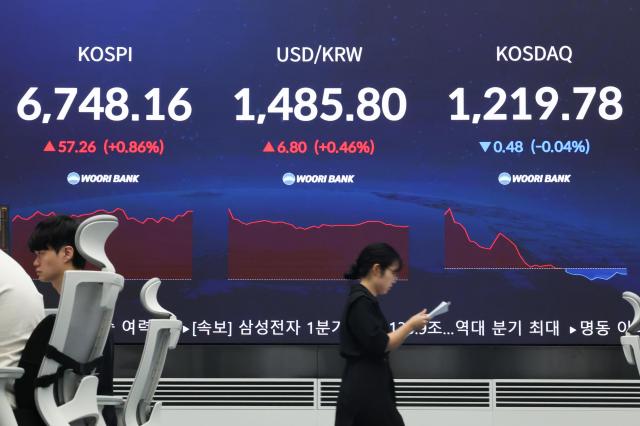
On Wednesday, the benchmark KOSPI closed at a record 6,690.90, supported by stronger-than-expected 1.7 percent first-quarter growth and blockbuster earnings from Samsung Electronics and SK hynix, whose combined operating profit exceeded 95 trillion won ($63.9 billion).
The earnings surge has fed directly into share prices. Samsung Electronics rose above 220,000 won on Wednesday, while SK hynix hit a record high above 1.3 million won on Thursday.
Market volatility has eased from March’s shock levels. After swinging more than 10 percent following the de facto blockade of the Strait of Hormuz on March 4, the KOSPI has trended steadily higher since mid-April. The last “buy sidecar” was triggered on April 9, when the index jumped 6.9 percent.
The KOSPI Volatility Index (VKOSPI), which spiked to a record 80 on March 4, eased to around 54 on Thursday, suggesting investors are increasingly treating the conflict as a persistent backdrop rather than an acute shock.
“Geopolitical threats are episodic; over time, markets revert to corporate fundamentals,” said Lee Kyung-min, a researcher at Daishin Securities.
The mood in foreign exchange and bond markets, however, remains fragile.
The Korean won has shown elevated volatility, with daily swings averaging 0.55 percent between April 11 and Thursday — higher than those of the South African rand (0.47 percent) and the Turkish lira (0.50 percent).
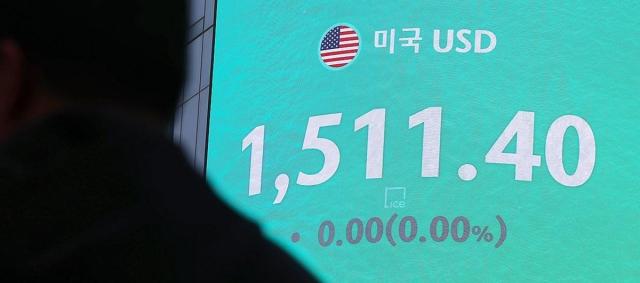
Although the won has recovered from its March 31 low of 1,530 per dollar, it averaged 1,487 in April, weakening about 2 percent from January’s 1,458. The currency remains vulnerable to energy shocks, as South Korea imports roughly 70 percent of its crude oil via the Strait of Hormuz.
Fuel prices are already reflecting the strain. Gasoline in Seoul has climbed above 2,000 won per liter, while the Consumer Sentiment Index fell below 100 in April for the first time in a year.
Industrial activity is also showing signs of stress. Mining and manufacturing output rose just 0.3 percent in March, sharply slowing from 5.3 percent growth in February.
Policy uncertainty in the United States has added another layer of pressure.
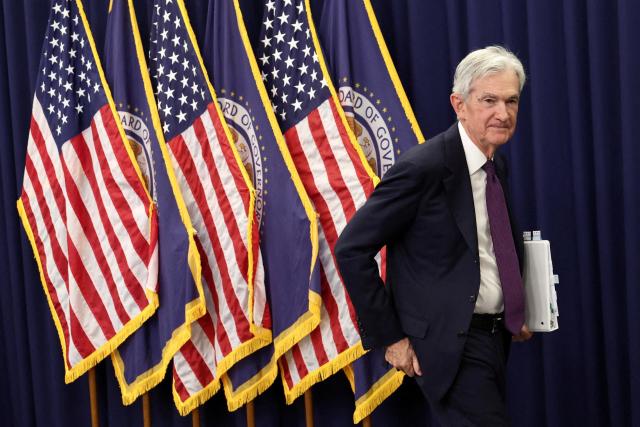
The Federal Reserve on Wednesday left its benchmark rate unchanged, with the upper bound at 3.75 percent. Chair Jerome Powell, in his final meeting, signaled the possibility of rate cuts, even as incoming leadership under Kevin Warsh is expected to lean more hawkish.
The decision exposed divisions within the 12-member committee, drawing four dissenting votes. Governor Steven Myron called for immediate cuts, while three regional presidents pushed back against what they viewed as overly dovish guidance.
Reflecting the uncertainty, the won opened at 1,486.5 per dollar on Thursday, weakening by 7.5 won.
Government bonds have also come under pressure. The three-year Treasury yield rose 4.3 basis points to 3.568 percent in Thursday morning trade, the highest since November 2023, while the five-year yield climbed 4.1 basis points to 3.888 percent.
Gains from South Korea’s inclusion in the World Government Bond Index (WGBI) on April 1 have effectively been erased by geopolitical risk.
“If markets scale back expectations for U.S. rate cuts, bond prices will fall further, adding pressure on the currency,” said Ahn Jae-kyun, a researcher at Shinhan Securities. “This trend is likely to persist until the bottleneck in the Strait of Hormuz is resolved.”

Copyright ⓒ Aju Press All rights reserved.