

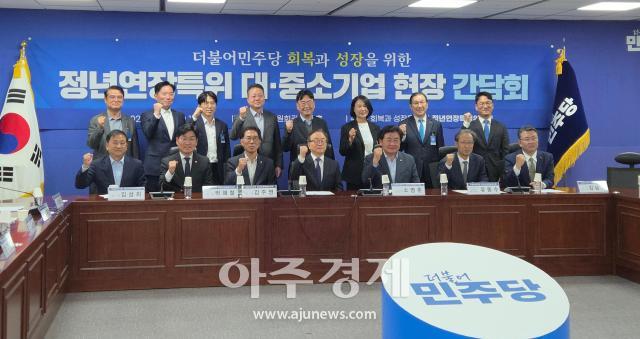
On the 30th, the Democratic Party’s special committee on extending the retirement age held a meeting with business representatives from large and small companies to discuss directions for overhauling wage systems.
Business groups say they can accept a higher retirement age, but only if wage systems are restructured. The Korea Employers Federation said it recently interviewed many Japanese companies, where continued employment after age 60 has been established earlier than in South Korea, to review how the policy was introduced and how it operates in practice.
The federation is calling for a compromise that allows voluntary implementation reflecting each company’s personnel system. It also wants to ease the added labor-cost burden of keeping older workers by shifting to job- and performance-based pay. A uniform wage cut, it argues, could weaken motivation and reduce productivity, so compensation should be differentiated based on expertise and results.
According to the federation, Japan shares the social costs of extending older-worker employment among labor, management and government. Companies employ all applicants, but wages upon rehire are adjusted to about 20% to 30% below previous levels, with the government covering a substantial portion.
Japan keeps the legal retirement age at 60 but requires measures to secure employment through 65. Companies choose one of three options: rehiring, extending retirement, or abolishing retirement. Japan has also reduced corporate burdens by allowing changes to work rules deemed socially reasonable without going through labor-management agreement procedures.
Nissan Motor, for example, provides differentiated incentives to workers over 60 who deliver performance or have strong technical skills.
Lee Dong-geun, vice chairman of the Korea Employers Federation, told Aju Business that because Japan’s industry and employment structure are similar, “the most desirable approach is a company-choice model following Japan’s precedent.” He added that if the retirement age is extended, “the wage system must also be reformed” to address concerns about reduced youth hiring.
Shin Chang-hoon, a managing director at Lotte Holdings, said problems tied to seniority-based pay are serious, adding that if flexibility in seniority and employment is secured, extending the retirement age “would not be a big issue.”
An industry official said no agreement was reached at the meeting. “It was simply a chance to hear companies’ situations,” the official said, adding that discussions would likely become more substantive after local elections.
With labor and management far apart on wage cuts, conflict is expected to continue during the legislative process.
Participants included the Korea Employers Federation, the Korea Federation of SMEs, Samsung Global Research, Hyundai Motor, SK Supex Council, LG Electronics and Lotte Holdings.
* This article has been translated by AI.
Copyright ⓒ Aju Press All rights reserved.