

As a temporary suspension of heavier capital gains taxes for multi-homeowners nears its end, both gift transfers and direct, broker-free apartment deals are rising in Seoul. With higher tax rates set to return, some owners are moving beyond straightforward sales, turning to options such as debt-assumption gifts and discounted transfers within families to cut tax bills.
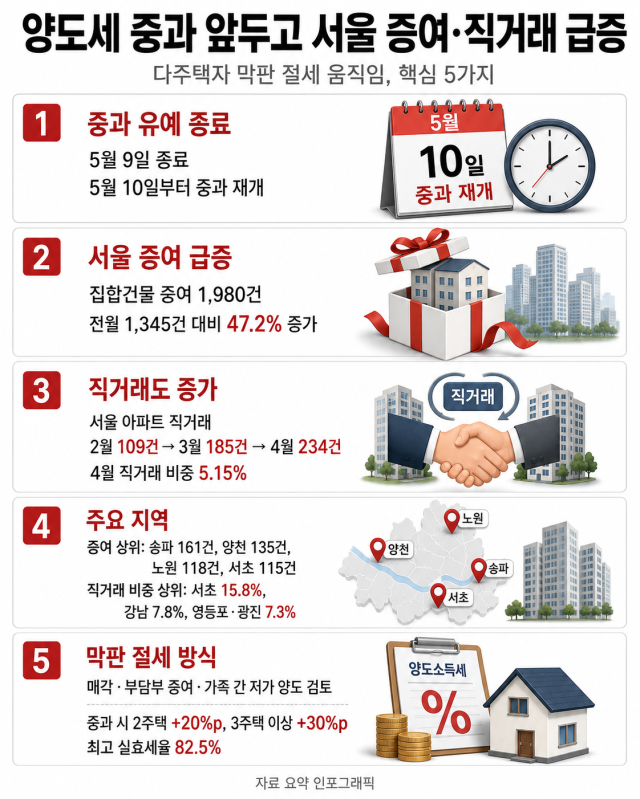
According to the Supreme Court’s registry information system, Seoul recorded 1,980 gift-transfer registrations for “collective buildings” last month, up 47.2% from 1,345 the previous month. It was the highest monthly total since December 2022, when there were 2,384. The category includes apartments, multi-family housing and officetels.
Nationwide, gift-transfer registrations totaled 5,560, the highest since December 2022, when 9,342 were recorded ahead of a change in the tax base for gift acquisition taxes. The latest increase is widely seen as an effort to reduce taxes before the end of the capital gains tax break for multi-homeowners. With sales of homes with tenants allowed through May 9, more owners appear to be transferring homes to children through debt-assumption gifts.
By district in Seoul, Songpa led with 161 cases, followed by Yangcheon with 135, Nowon with 118, Seocho with 115, Yongsan with 106, and Gangnam and Dongjak with 104 each. Yongsan nearly doubled from 54 the previous month, up 95.3%. The rise in both high-priced areas such as Gangnam and Yongsan and in districts such as Yangcheon and Nowon suggests tax-driven demand is spreading across the city.
Direct apartment transactions in Seoul have also increased, according to the Ministry of Land, Infrastructure and Transport’s real transaction disclosure system. Such deals rose from 109 in February to 185 in March and 234 in April. Direct transactions accounted for 5.15% of 4,544 reported apartment deals in April. These transactions bypass licensed brokers and often involve family members or other related parties.
In April, Seocho had the highest share of direct transactions at 15.8%. Gangnam posted 7.8%, while Yeongdeungpo and Gwangjin each recorded 7.3%. Market watchers say some of the activity reflects demand to transfer homes to relatives at below-market prices before heavier capital gains taxes resume.
Under the inheritance and gift tax law, even transactions between related parties are treated as normal sales — and not subject to gift tax — if the reported price is within the smaller of 30% below the most recent three-month transaction price or 300 million won. Some multi-homeowners appear to be using direct transactions to reduce holdings before the higher tax rates take effect.
The suspension of heavier capital gains taxes for multi-homeowners ends May 9. Starting May 10, multi-homeowners selling homes in regulated areas will face surcharges on top of the basic tax rate: 20 percentage points for two-home owners and 30 percentage points for those with three or more. Including local income tax, the effective top rate can rise to 82.5%.
The government has announced supplemental steps to reduce confusion as the break ends. If a land-transaction permit is filed by May 9 and the sale process — including final payment and registration — is completed within a set period, sellers can avoid the heavier tax. For the three Gangnam districts and Yongsan, the process must be completed by Sept. 9; for Seoul’s other 21 districts and 12 areas in Gyeonggi Province, the deadline is Nov. 9.
An exception also applies to homes with tenants. If a lease existed as of Feb. 12 and a land-transaction permit is filed by May 9, the requirement for the buyer to live in the home is deferred until the lease ends, but only when the buyer is a first-time homeowner.
An industry official said “last-minute tax-saving moves by multi-homeowners are likely to continue” and that when a simple sale is difficult, more owners may consider gifts, debt-assumption gifts or direct transactions with related parties. The official also warned that discounted transfers and debt-assumption gifts could later face scrutiny by tax authorities, making it important to carefully assess pricing and the requirements for taking over debt.
* This article has been translated by AI.
Copyright ⓒ Aju Press All rights reserved.