

In a commentary carried by the official Korean Central News Agency (KCNA) on Friday, Pyongyang cast the biennial exercise as a rehearsal for war that was dragging the Pacific into dangerous turbulence, and said regional states had an inviolable right to bolster their own war deterrence in response.
KCNA said the "reckless racket" of what it called international ruffians would inevitably invite a chain of proportional responses from countries seeking to firmly rein it in. It heaped scorn on the United States, South Korea and Japan alike, likening the drill to outsiders lighting a fire at a neighbor's doorstep.
The commentary is notable for reviving the epithet "puppet," a term North Korean media had not aimed at the current South Korean government in about one year and three months, since an April 2024 incident involving a South Korean air force fighter jet.
North Korea took particular aim at Seoul's expanded footprint, asserting that South Korea had joined "as a main force." The South Korean Navy, a RIMPAC participant since 1990, this year commanded the exercise's combined maritime component for the first time, overseeing the operations of a multinational fleet.
Pyongyang also seized on the exercise's embrace of new technology, noting that artificial intelligence had been introduced and that the integrated operation of manned and unmanned weapons systems had been made a core training focus.
"The Pacific has now turned into a battlefield thick with the smell of gunpowder, regardless of its name," KCNA said, warning that undesirable developments could soon unfold on the Korean peninsula.
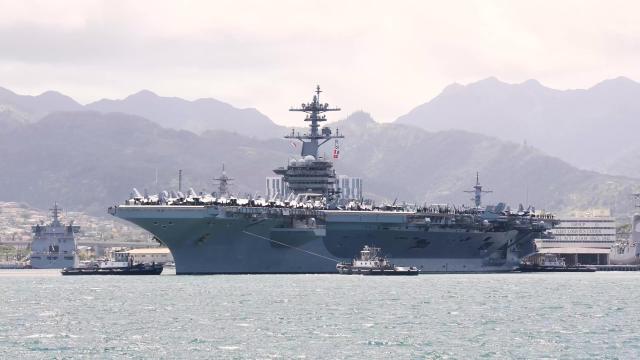
RIMPAC 2026, which the U.S. Navy says draws 30 nations, began June 24 and runs through July 31 in and around Hawaii, led by the aircraft carrier USS Theodore Roosevelt.

Copyright ⓒ Aju Press All rights reserved.
