

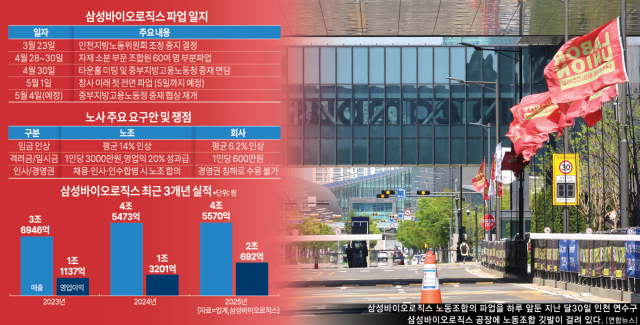
Samsung Biologics’ first full-scale strike since the company was founded in 2011 continued for a third day on Saturday, raising concerns about production disruptions and damage to customer confidence. The union is pressing for a major pay and bonus package and has also sought prior consent rights on key management matters such as hiring, personnel evaluations and mergers and acquisitions, prompting criticism that it is hardening its stance rather than seeking compromise.
◆5-day strike began May 1···Company estimates 640 billion won loss if it runs full term
According to the Samsung Biologics branch of the Samsung Group National Union, the union began a full strike on May 1, Labor Day, and plans to continue through May 5. The union said about 2,800 of its roughly 4,000 members are taking part. It said the action is being carried out without separate rallies, including by using annual leave and refusing holiday work.
The company estimates that if the strike continues for the planned five days, losses could total about 640 billion won. That is about half of Samsung Biologics’ first-quarter revenue of 1.2571 trillion won and exceeds its operating profit of 580.8 billion won for the same period.
Labor and management are expected to return to the bargaining table on May 4 under mediation by the Jungbu Regional Office of Employment and Labor, but the gap remains wide. The union is seeking an average 14% wage increase, a 30 million won per-person incentive payment, and a bonus pool equal to 20% of operating profit. The company has offered a 6.2% wage increase and a one-time payment of 6 million won.
The union is also reported to have included in its collective bargaining demands a clause requiring prior union consent for new hiring, personnel matters and M&A. The company has said it cannot accept provisions it views as directly tied to management rights.
Human resources experts criticized the union’s proposal, saying hiring and adopting new technologies are essential strategies for corporate survival and that restricting them in the name of job security could weaken competitiveness. They added that authority and responsibility for management rest with executives.
◆Talks stalled···Union leadership’s negotiating posture also questioned
Samsung Biologics and the union held 13 rounds of talks from December through March without reaching an agreement. With a full strike scheduled for May 1, the union also carried out surprise walkouts in some processes from April 28 to 30. The company said those actions halted a filling process, disrupted supplies of raw and packaging materials, and delayed production of key medicines including cancer drugs and HIV treatments, estimating losses of about 150 billion won over that period.
A tripartite meeting hosted April 30 by the Jungbu office of the Employment and Labor Ministry also failed to narrow differences. The union chair was reported to have been absent due to overseas travel plans, drawing criticism from some quarters amid concerns over production disruptions and customer trust. Other union officials were also criticized after presenting, as a precondition, a demand that the company replace all of its bargaining representatives.
In a statement issued the afternoon of May 1, the company said negotiations had been difficult because the union’s demands were not realistically acceptable, adding that issues directly tied to personnel authority and management rights were especially hard to bridge.
Industry officials have warned that a prolonged strike could not only deepen production-related losses but also affect future global contract competition. Samsung Biologics posted annual revenue of 4.5570 trillion won and operating profit of 2.0692 trillion won last year, achieving more than 30% growth from the previous year. But in the contract manufacturing organization industry, where stable production capacity is a key competitive factor, an extended labor dispute could disrupt contract performance and new orders from global customers.
A Samsung Biologics official criticized the union’s demands and strike tactics, urging it to stop what the company called unreasonable demands and coercive pressure to join the strike and to return to talks with a sense of responsibility.
* This article has been translated by AI.
Copyright ⓒ Aju Press All rights reserved.