

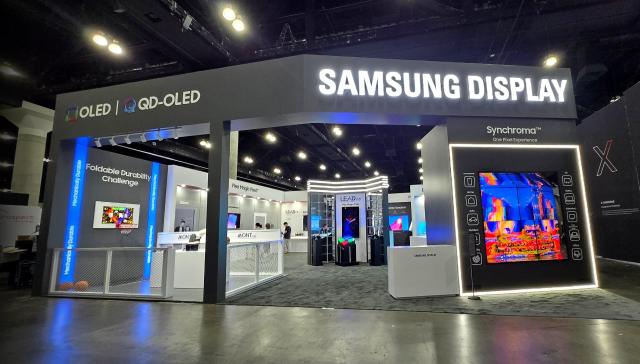
Samsung Display and LG Display are showcasing next-generation technologies at Display Week 2026 (SID 2026), the world’s largest display event, as they compete for leadership in the global market.
Industry officials said Tuesday the companies will present differentiated technology road maps at the exhibition, held May 5-7 (local time) at the Los Angeles Convention Center. Samsung Display is highlighting “display innovation expanded by AI,” while LG Display is focusing on “the evolution of OLED for the AI era.”
Samsung Display highlights wide-color-gamut OLED and privacy-focused sensor OLED
Samsung Display is emphasizing what it calls a lead in picture quality and “converged” displays. It is unveiling a wide-color-gamut OLED that supports 3,000 nits of peak brightness and 96% of the BT.2020 color space. The company is also showing, for the first time, a product combining 500 PPI organic photodiode (OPD) technology with its Flex Magic Pixel (FMP) privacy feature.
The company said the wide-color-gamut performance significantly exceeds the limits of existing smartphone OLEDs, which it said have remained around 70% of BT.2020. It said a low-power structure called LEAD technology, paired with next-generation emissive materials, improves brightness, lifespan and color accuracy at the same time.
Samsung Display is also featuring a “sensor OLED” that integrates sensing functions into the display. The 6.8-inch panel delivers 500 PPI resolution and includes functions to measure biometric information such as heart rate and blood pressure. The company said it also applies FMP to selectively block sensitive information from side viewing angles, strengthening privacy protection.
Another technology on display is EL-QD, a next-generation emissive approach that directly drives quantum dots with electrical signals. Samsung Display said it achieves 500 nits of brightness and boosts luminance by up to 33% compared with previous levels. It said its research on improving luminous efficiency was selected as an SID “distinguished paper.” The company is also presenting a 200 PPI stretchable display to demonstrate a future vehicle user experience in which an instrument panel can deform in three dimensions.
Lee Chang-hee, Samsung Display’s chief technology officer, said, “We are pleased to introduce the company’s latest technologies and R&D achievements to leading scholars and industry experts through SID 2026.” He added, “Samsung Display will continue to lead display innovation through sustained R&D and serve as a technological compass that guides customers and the market.”
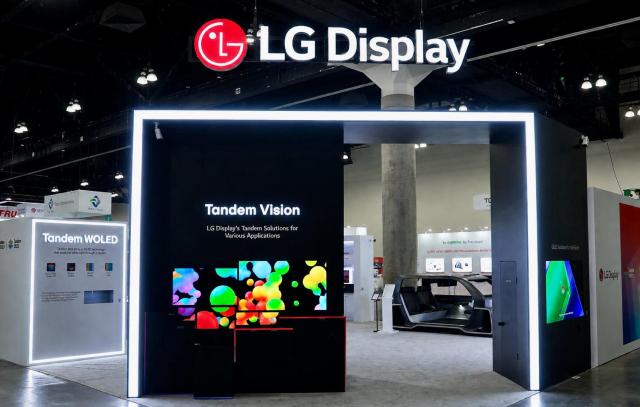
LG Display debuts third-generation tandem OLED after three years
LG Display is promoting an OLED strategy centered on durability and power efficiency, led by what it called the world’s first public showing of its “third-generation tandem OLED.” The company said it is the first unveiling of the next-generation technology in three years, following mass production of second-generation tandem OLED in 2023.
LG Display said the stacked-device structure improves both brightness and lifespan, operating stably for more than 15,000 hours at 1,200 nits. It said power consumption is reduced by 18% and lifespan is increased by more than twofold compared with existing technology.
The company said it plans to expand tandem OLED applications from automotive displays to IT and mobile devices. It also said it is showing P-OLED for humanoid robots for the first time as it targets the “physical AI” market, emphasizing that flexible, plastic-based displays can support varied robot designs and maintain stable performance in extreme environments.
LG Display also showcased premium products, including an OLED TV panel with up to 4,500 nits of brightness, a 720Hz ultra-high-refresh gaming panel, and a 5K2K curved OLED. It also presented a 220 PPI high-resolution OLED and a tandem OLED for AI laptops, aiming at next-generation IT devices through lower power use and lighter designs. The company said the approach reduces thickness and weight while extending battery use by 2.3 hours through low power consumption.
In addition, LG Display is exhibiting automotive display solutions optimized for SDVs (software-defined vehicles). In concept-car form, it is showing a 57-inch pillar-to-pillar panel spanning the driver and passenger sides, and a 32-inch slidable OLED that rolls into the ceiling and lowers when in use.
Choi Young-seok, LG Display’s chief technology officer, said the company has led “world-first and best” OLED innovation based on its R&D competitiveness. He said it will continue to prioritize customers and strengthen technology leadership as a “technology-driven company” to lead the future display market.
* This article has been translated by AI.
Copyright ⓒ Aju Press All rights reserved.