

The history of a company is recorded in numbers, but its fate ultimately hinges on choices. This conclusion aligns with my research on entrepreneurship. Companies do not grow solely through strategy; they leap forward through decisions. Strategies can be adjusted at any time, but decisions change the direction. These decisions are always made amidst incomplete information. The ability to manage that uncertainty is the essence of entrepreneurship.
From this perspective, the recent news that Lee Jae-Yong has topped brand reputation rankings is not merely a matter of popularity. It signals that the market and society are once again focusing on Samsung and Lee Jae-Yong. More precisely, it indicates that expectations are building. Expectations always come with questions: Where is Samsung headed, and what will Lee Jae-Yong choose? These questions carry more weight now than ever.
Looking back at Samsung's history, some answers have already been provided. Samsung has always made leaps not during times of success but when it took risky decisions. A prime example is its investment in semiconductors. At that time, Samsung lacked technology, the market was uncertain, and there was significant internal opposition. Objectively, the chances of failure outweighed those of success. Yet, a decision was made. This choice stemmed not from calculations but from perception. The judgment that "if we don't act now, we never will" transformed the company. In that moment, Samsung became a company of decisions rather than just strategies.
At this juncture, the essence of entrepreneurship becomes clear. Economist Joseph Schumpeter defined entrepreneurs as those who execute "creative destruction." The power to disrupt the existing order and create a new one is what defines entrepreneurship. Frank H. Knight viewed it as the ability to manage uncertainty. He explained that taking risks in areas that cannot be insured is the entrepreneur's role. Joseph Schumpeter emphasized the agility to discover opportunities and act on them. Although these three definitions may seem different, they ultimately converge. Capturing opportunities in uncertain situations, making decisions, and taking responsibility for the outcomes—that is entrepreneurship.
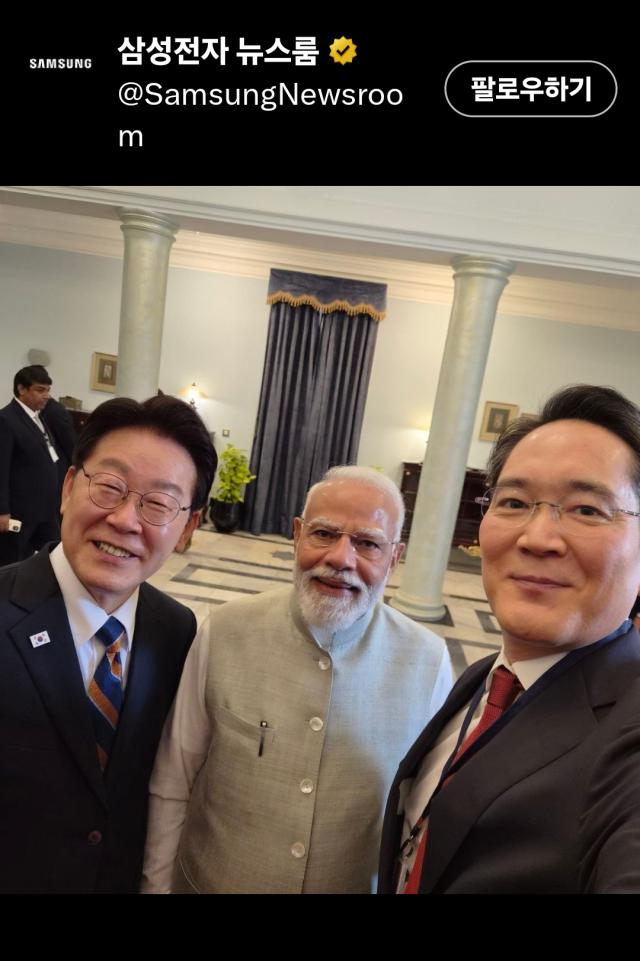
The issue is now. Lee Jae-Yong's recent period has been more about consolidation than expansion. He has been managing legal risks, stabilizing governance structures, and handling substantial inheritance taxes. All of this was a necessary process to eliminate external uncertainties. Without this groundwork, no investment or strategy would have held meaning. In that sense, this period can be seen not as a lack of entrepreneurship but as a time to lay the groundwork for exercising it.
However, entrepreneurship does not manifest during the preparation phase. It reveals itself at the moment of choice. And that moment is now. Samsung must transition back to a phase of expansion. Lee Jae-Yong is now expected to fulfill his role as an entrepreneur rather than merely a manager. If the time for consolidation has ended, then the time for decisive action must begin.
More importantly, the era has changed. AI is transforming the very structure of entrepreneurship. In the past, information asymmetry was central to entrepreneurship. The competitive edge lay in who could acquire information faster, analyze it more accurately, and act sooner. But that is no longer the case. Information is abundant, analysis is automated, and predictions are made by algorithms. In this context, the differentiating factor is no longer information but responsibility. In an age where AI handles analysis, what remains is human choice and the accountability that comes with it. Ultimately, entrepreneurship becomes a matter of attitude rather than ability.
From this perspective, the challenges facing Samsung become clear. The first challenge is determining the direction beyond semiconductors. Samsung remains a semiconductor-centric company. Semiconductors are its heart and will continue to play a crucial role. However, in the AI era, the winners will not be semiconductor companies but platform companies. As seen with Apple, Amazon, and Google, companies that build ecosystems beyond hardware dominate the market. Samsung is also confronted with this question: Will it remain a manufacturing-centric company or expand into a platform company? This choice is not merely a technical issue but a matter of entrepreneurship. It is a question of whether to maintain existing success formulas or to reject them and choose a new path.
The second challenge is organizational fairness. Recent controversies over compensation structures within Samsung are not just wage issues. They raise fundamental questions about whether the organization is perceived as fair. My research repeatedly confirms that organizations with vibrant entrepreneurship tend to have fair structures. When fairness is ensured, members are encouraged to take risks. When risk-taking is possible, innovation occurs. Conversely, when fairness erodes, challenges disappear, organizations become conservative, and ultimately lose competitiveness. Fairness is not a choice; it is a prerequisite.
The third challenge is responsible leadership. In the AI era, leaders are no longer those who merely give orders. They are the ones who stand before the results. Leaders who blame technology or the environment when problems arise cannot gain trust. Only those who acknowledge responsibility and provide direction can move an organization forward. The Boeing case starkly illustrates this. Technical explanations alone could not restore market trust, but by acknowledging responsibility and reorganizing, they created a pathway to recovery. Entrepreneurship is completed in these moments of accountability.

It is also necessary to revisit the characteristics of Korean-style entrepreneurship. Korean companies did not wait for perfect conditions. They executed quickly, mobilized their organizations, and found direction amid crises. This spirit of speed and decisiveness has driven the growth of the Korean economy. However, this spirit is now waning. A focus on stability, risk aversion, and distributed responsibility is eroding entrepreneurship. As companies grow, this tendency becomes stronger. Therefore, the role of leaders becomes even more critical. When organizations choose safety, leaders must choose risk. That is entrepreneurship.
Lee Jae-Yong's actions reveal a quiet yet consistent flow: an awareness of social responsibility. Initiatives like supporting the Joseph's Hospital are not mere donations; they represent a long-term commitment. Entrepreneurship is not just about the ability to make money but how that money is connected to society. The emphasis on ESG by global companies reflects this same context. Companies are no longer merely economic entities; they are expanding into social entities.
What remains now is the choice. Samsung has all the necessary conditions: funding, technology, talent, and a global network. What is lacking is not the conditions but the direction. And direction always begins with one person's decision. Entrepreneurship is not completed in a state of readiness; it is realized at the moment of choice. That choice moves organizations, changes markets, and alters the flow of industries.
Can Samsung make a decisive choice again? This question is now directed at Lee Jae-Yong. The answer has yet to emerge. However, the direction is clear. Ultimately, entrepreneurship boils down to one principle: to decide and to take responsibility. This simple principle explains everything.
Lee Jae-Yong stands at the most crucial point in Samsung's history. Will he repeat past success formulas, or will he create a new order? Will he make a stable choice or a risky one? Will he remain a leader of management or step up as a leader of decisions?
Entrepreneurship is not a grand concept. It is an attitude that reveals itself at the moment of choice. And that attitude determines the future of the company. Now is that moment.
* This article has been translated by AI.
Copyright ⓒ Aju Press All rights reserved.