

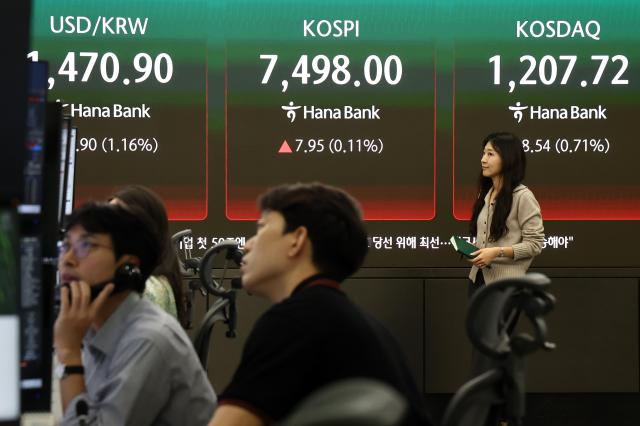
According to the Korea Exchange, the KOSPI index closed at 7498.00 on May 8, up 7.95 points (0.11%) from the previous trading day. Over the week from May 4 to May 8, the KOSPI and KOSDAQ rose by 13.90% and 1.29%, respectively.
This week, the domestic market continued its upward trend, fueled by a global semiconductor rally. Major semiconductor stocks, including Samsung Electronics and SK Hynix, attracted significant buying interest, pushing the KOSPI above 7500 during trading hours, with the market capitalization exceeding 600 trillion won. The strong performance of U.S. tech giants and growing expectations for investments in artificial intelligence (AI) have bolstered investor sentiment in the domestic semiconductor sector.
Notably, the earnings reports from U.S. hyperscalers reaffirmed the growing demand for AI, serving as a catalyst for market gains. Amazon, Microsoft, and Google reported results that exceeded market expectations, with notable increases in cloud revenues related to AI. This has strengthened expectations for increased global semiconductor investments, leading to strong performances in domestic sectors related to AI infrastructure, including semiconductors and power equipment.
Ha Geon-hyung, a researcher at Shinhan Investment Corp., stated, "While semiconductors remain the core focus, earnings forecasts have been adjusted in line with historical statistics following the first-quarter earnings announcements, and SK Hynix has reached appropriate valuations. We may see a slowdown in the explosive rise of the index around late May to June."
In terms of sector performance, semiconductors led the index's rise with over a 20% increase for the week. Other sectors, including securities, trading, capital goods, steel, machinery, and insurance, also recorded double-digit gains. Conversely, media, consumer staples, telecommunications, cosmetics, clothing, and hotel and leisure sectors lagged behind. Analysts suggest that a differentiated market trend is emerging, with funds concentrating on AI infrastructure-related sectors.
From a supply and demand perspective, foreign investors have been notably active, with net purchases exceeding 4 trillion won in the securities market this week, driving the index higher. However, some profit-taking movements have been observed amid the recent surge in semiconductor stocks, raising the possibility of sector rotation.
Market analysts expect the domestic stock market to continue its upward trend next week, but they caution about the potential for increased volatility due to short-term overheating. Significant events are on the horizon, including the release of the U.S. April CPI and Producer Price Index (PPI), the U.S.-China summit, and the end of Federal Reserve Chair Jerome Powell's term. In particular, the market will likely assess the implications of inflation data for potential interest rate cuts later this year.
Kim Yu-mi, a researcher at Kiwoom Securities, noted, "Both the U.S. and Iran face significant burdens from the prolonged conflict, suggesting that negotiations will continue. If the CPI does not significantly exceed market expectations, the negative impact on financial markets will be limited." She added that the U.S.-China summit will be a key point of interest, particularly regarding the potential easing of tariff conflicts and negotiations on semiconductor and rare earth supply chains.
Experts believe that the existing trend led by semiconductors is likely to persist. However, due to the recent surge, there may be some rotation into other sectors. Industries supported by strong earnings and momentum, such as telecommunications equipment, shipbuilding, secondary batteries, and renewable energy, are being considered as alternatives.
Na Jeong-hwan, a researcher at NH Investment & Securities, stated, "The current rise is based on upward earnings revisions. While maintaining core positions in leading sectors like semiconductors and power equipment, it is effective to expand portfolios into high-quality stocks within sectors where earnings revisions are gaining momentum."
* This article has been translated by AI.
Copyright ⓒ Aju Press All rights reserved.