

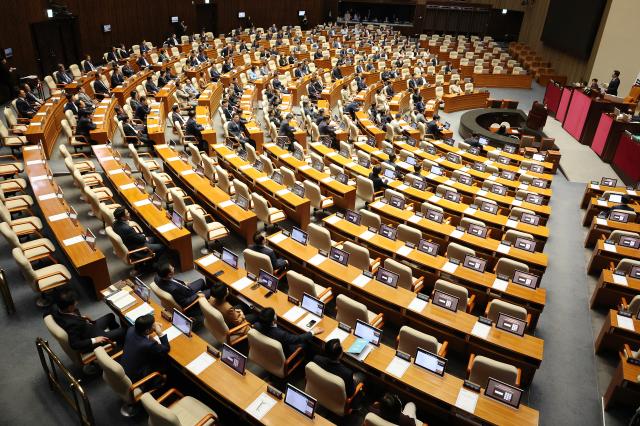
A proposed constitutional amendment aimed at reforming South Korea's governance has once again failed, marking the third unsuccessful attempt since the 1987 democratic transition. The initiative, which sought to hold a simultaneous national referendum on local elections and constitutional changes, did not pass through the National Assembly. The ruling People Power Party boycotted the vote and employed a filibuster strategy, leading National Assembly Speaker Woo Won-sik to withdraw the amendment from consideration. Discussions on constitutional reform have now reverted to square one.
The amendment was designed to focus on provisions with a higher likelihood of bipartisan agreement, excluding sensitive topics such as presidential power structure changes. Key elements included strengthening parliamentary control over martial law, enshrining the spirit of the May 18 Democratic Uprising in the constitution, and specifying the government's obligation for balanced regional development. Given the increased calls for formalizing martial law controls following the December 3 emergency martial law situation last year, there was some hope for progress in discussions.
However, the outcome was marked by extreme political polarization. The Democratic Party argued that the proposed amendment represented a "minimal consensus," while the People Power Party criticized it as a "hasty amendment ahead of elections." Ultimately, both parties wasted significant time accusing each other of "kicking away the opportunity for reform" and attempting a "dictatorial amendment."
Constitutional amendments are inherently challenging, as they involve establishing a framework for governance that transcends partisan interests. Therefore, bipartisan cooperation is crucial. Neither side should push through changes solely based on numerical advantage, nor should they block reforms purely for political gain. The constitution should not be treated as a trophy for the majority or a tool for obstruction by the minority.
The most glaring issue revealed during this failed attempt was the apparent absence of genuine political engagement. Both parties have acknowledged the necessity for constitutional reform. They recognize that the current constitution was established in the context of ending military rule and direct elections in 1987, and that the concentration of presidential power and recurring partisan conflicts have led to a growing demand for institutional reform. Yet, the National Assembly has focused more on political maneuvering than on substantive discussions about the amendment's content.
The public is understandably fatigued. Lawmakers have repeatedly emphasized the need for constitutional reform during election cycles, but when it comes to actual legislative action, conflicts and failures have been the norm. The attempt to amend the constitution during the Moon Jae-in administration in 2018 also failed, and discussions on power structure and electoral reforms have stalled since then. This latest episode has repeated that pattern.
However, it is essential not to abandon the discussion on constitutional reform. This failure highlights the need for a more systematic and realistic approach. In the second half of the 22nd National Assembly, both parties should reconvene a constitutional amendment committee and seriously consider a step-by-step consensus model. If a comprehensive overhaul of the power structure is currently unfeasible, they could start by reaching agreements on areas where there is already social consensus, such as enhancing martial law controls, decentralization, and expanding citizens' fundamental rights.
Above all, the attitude of the political parties is crucial. If constitutional reform is used as a political strategy by a specific faction, consensus will become impossible. The ruling party must avoid unilateral actions based on numerical superiority, while the opposition should not create the impression of opposing for the sake of opposition. The constitution endures beyond the terms of any administration, necessitating a more cautious and responsible approach.
Constitutional reform is not merely a matter of victory or defeat for any single party; it is about whether South Korean politics can transcend its current extreme polarization. If this failure is dismissed as just another political skirmish, public trust in the National Assembly will further erode. Both parties must reopen the door to negotiation in the second half of the 22nd National Assembly. This is the minimum responsibility of politics to move beyond a 39-year-old system.
* This article has been translated by AI.
Copyright ⓒ Aju Press All rights reserved.