

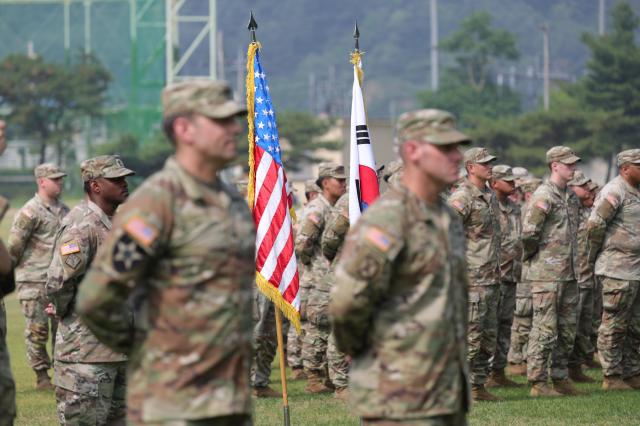
The discussion surrounding the transition of wartime operational control (WOC) is once again at the forefront of U.S.-South Korea security issues. Ahead of the Security Consultative Meeting (SCM) in the second half of this year, both nations are intensifying the verification process for this transition. Speculation about a possible transition in 2028 or 2029 is circulating among government officials and analysts.
However, the current discussions on wartime operational control are taking place in a vastly different international context, necessitating a more cautious approach.
The issue of wartime operational control is not merely a symbol of 'military sovereignty.' It involves redesigning who will command and respond to the allied forces in the event of a crisis on the Korean Peninsula. With North Korea's advanced nuclear and missile capabilities, the military alignment between North Korea and Russia, U.S.-China strategic competition, and changes in the role of U.S. forces in South Korea all occurring simultaneously, the transition of wartime operational control cannot be treated as a mere political slogan.
Recent messages from the U.S. side have been relatively clear. The U.S. is demanding an expanded role for the South Korean military. The Trump administration publicly emphasized the need for allied nations to strengthen their defense responsibilities, asserting that South Korea should take a central role in conventional defense on the peninsula. In fact, the U.S. National Defense Strategy (NDS) highlights the need for South Korea to play a leading role in deterring North Korea, and U.S. forces in South Korea have repeatedly mentioned the necessity of 'modernizing the alliance.'
The challenge is that the 'modernization of the alliance' as described by the U.S. goes beyond mere role adjustments. It is connected to the U.S. Indo-Pacific strategy. If U.S. forces in South Korea transfer some of the defense burden to the South Korean military, the U.S. can gain greater strategic flexibility to counter China. In other words, the discussions on wartime operational control are situated at the intersection of South Korea's self-defense logic and the U.S.'s global strategy.
As a result, South Korea's calculations are becoming increasingly complex. While it cannot indefinitely delay the transition, it also cannot rush it to align with political schedules. Notably, U.S. Forces Korea Commander General Xavier Brunson recently stated, "Political convenience should not take precedence over conditions," publicly advocating for caution. He added, "Choosing a shortcut could jeopardize our readiness posture."
In reality, there is a subtle temperature difference between the U.S. and South Korea. The South Korean government emphasizes its commitment to transitioning wartime operational control within its term, while the U.S. continues to stress a 'conditions-based transition.' Both nations agree on the necessity of the transition itself, but the U.S. appears to prioritize strategic flexibility for U.S. forces in South Korea and the realignment of the alliance.
Another concern is the approach taken by the political sphere. The issue of wartime operational control should not be consumed by partisan logic. In the past, discussions of 'early transition' and 'delay' have recurred with each change of administration, undermining the consistency of security policy. However, the current security environment is far more unstable than it was during those times. North Korea has effectively institutionalized its nuclear capabilities and is strengthening military cooperation with Russia. The international security order has also been rapidly shaken since the Middle East conflict.
That said, maintaining the current system indefinitely is not a solution either. The South Korean military's capabilities have grown significantly compared to the past. Its reconnaissance, missile, space, and cyber capabilities are expanding. It is no longer possible to deny the need to enhance self-defense capabilities. However, what matters is not the speed of the transition but the level of preparedness and strategic direction.
Especially after the transition of wartime operational control, there must be a national explanation and verification regarding whether the U.S.-South Korea joint defense system can operate stably, how the U.S. will maintain its extended deterrence commitments, and how the response system to North Korean nuclear threats will be adjusted. Security must be backed by actual operational capabilities, command structures, and joint response systems.
Ultimately, the transition of wartime operational control is not merely a political issue but a matter of national survival strategy. What South Korea needs now is neither emotional self-defense rhetoric nor vague security dependence. It requires a rational assessment centered on national interests. In an increasingly complex security environment, what is needed more than a race against time is a meticulous strategy.
* This article has been translated by AI.
Copyright ⓒ Aju Press All rights reserved.