

"Feels like a Korean store"... Counterfeit Korean ramen floods Nepali resort
![Samyang Foods' 'Buldak Bokkeummyeon' and a similar local product from 'HANKOOK' found in a Nepali store. The local product uses design elements reminiscent of Korean products, including a black package and a chicken character. [Photo by Kim Hyun-ah]](https://image.ajunews.com/content/image/2026/05/11/20260511160124157023.jpg)
On May 8, at a supermarket in Pokhara, Nepal, a popular tourist destination just a 10-minute walk from Phewa Lake, the ramen aisle was the first thing to catch the eye. Most of the products on the shelves featured Korean writing, creating a familiar atmosphere reminiscent of a Korean grocery store.
Upon closer inspection, however, a strange sense of unease emerged. While the products appeared to be Korean, they were actually from local and overseas brands. The most notable was a stir-fried noodle product branded as 'HANKOOK.' Its design, featuring a black background with a chicken character breathing fire, strongly evoked Samyang Foods' Buldak Bokkeummyeon. The English label 'BULDAK' and the product name 'Buldak Bokkeummyeon' were nearly identical, and the phrase 'Taste of Korea' was placed where a 'Made in Korea' mark would typically appear, adding to the confusion. The original product, along with its pink-packaged counterpart, was being sold under the same guise.
As I continued to browse the aisle, more similar products caught my attention. The use of Korean writing varied widely. The Nepali ramen brand 'Current' prominently displayed the word '현재' (meaning 'current') on its packaging, while 'Jackpot' included the phrase '공동자금' (meaning 'joint fund'), which was completely unrelated to ramen.
Many products emphasized spiciness by incorporating Korean words. Phrases like '악마의' (meaning 'devil's') and '라라 매콤한' (meaning 'spicy') were scattered throughout the shelves. A local store employee remarked, "The important thing is that it has Korean writing; it creates a perception that it’s a Korean ramen, which increases its popularity."
Consumer reactions were similar. Robin, a 28-year-old from India, selecting products in front of the shelf, said, "I didn’t know the HANKOOK product was a knockoff. I just assumed it was Korean ramen because it had Korean writing on it." He added, "I chose it because it was cheaper than the original."
From Southeast Asia to Japan... The resurgence of 'K-style' products without clear nationality
![Local products resembling Korean ramen are displayed in a large supermarket in Pokhara, Nepal. They borrow design elements from Buldak Bokkeummyeon, including black and red packaging and Korean product names. [Photo by Kim Hyun-ah]](https://image.ajunews.com/content/image/2026/05/11/20260511160303779921.jpg)
This phenomenon is not limited to Nepal. As the popularity of K-food rises, local products across Asia are increasingly adopting Korean-style packaging and Korean writing. This trend goes beyond merely importing and selling Korean products; local companies are actively mimicking the design and naming conventions of Korean ramen.
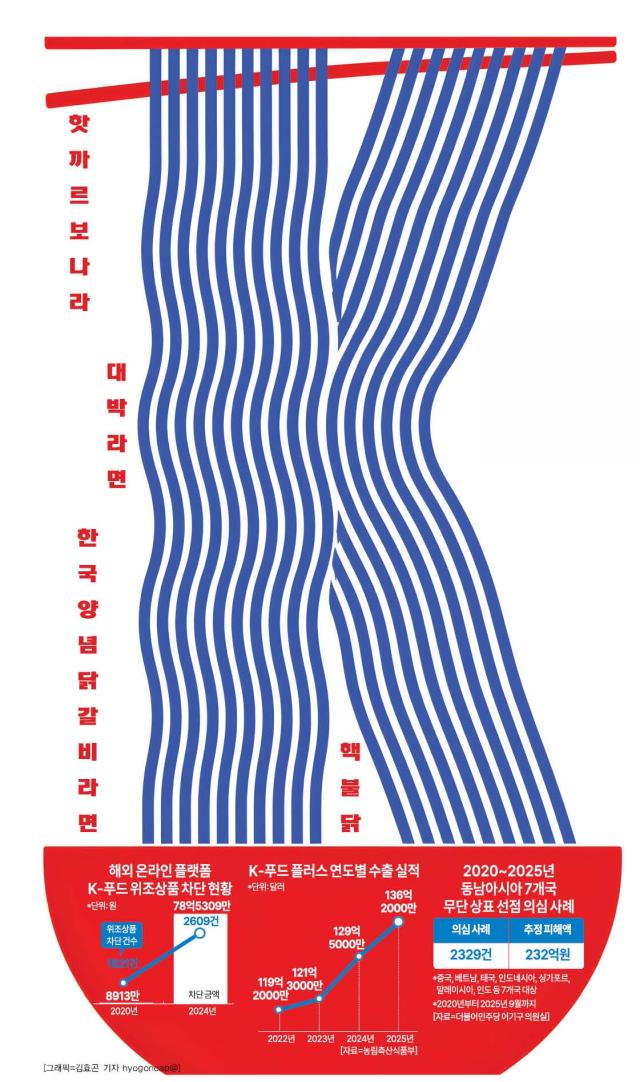
A prominent example is in the Indian market. The large food company ITC is selling 'Daebak Ramen' under its instant noodle brand 'Yippee.' The product prominently features the Korean word '대박' (meaning 'big hit') on the front, using a striking black and red color scheme to emphasize the image of spicy Korean ramen. The word 'Korean' is also included to highlight the concept of Korean ramen.
Indonesia is witnessing a similar trend. The local ramen brand Mie Sedaap has introduced a product concept called 'Korean Seasoned Dak Galbi Ramen,' featuring the Korean phrase '양념 닭갈비' (meaning 'seasoned chicken galbi') on its packaging and emphasizing flavors of smokiness and spiciness with a red color design.
Japan, known as the birthplace of instant ramen, is also not exempt. Local brands in Japanese convenience stores and supermarkets prominently display products labeled 'Korean Jjamppong' and 'Korean-style ramen.' Many products feature Korean writing more prominently than Japanese, or use red and black designs to emphasize the image of spicy Korean ramen.
Nissin Foods, Japan's largest ramen company, has previously faced controversy. Its 2023 product 'Nissin Yakisoba U.F.O. Stir-fried Noodles Korean-style Sweet and Spicy Carbonara' received criticism for its pink packaging and product concept being similar to Samyang Foods' 'Carbonara Buldak Bokkeummyeon.' The use of the Korean term '볶음면' (meaning 'stir-fried noodles') in the product name also drew attention.
Industry experts attribute this trend to the success of K-ramen, particularly centered around Shin Ramyeon and Buldak Bokkeummyeon. According to the Ministry of Agriculture, Food and Rural Affairs, K-food exports reached a record high of $13.62 billion last year, a 5.1% increase from the previous year. Notably, ramen exports surged by 21.9% to exceed $1.52 billion, marking the first time a single item surpassed the $1 billion mark. The growth trend continues this year, with ramen exports in the first quarter reaching $435 million, a 26.4% increase from the previous year.
“Image theft while evading legal frameworks”... Food industry faces brand erosion
![A cup noodle product sold at a Lawson convenience store in Japan features the Korean expression 'Korean Jjamppong.' [Photo by Kim Hyun-ah]](https://image.ajunews.com/content/image/2026/05/11/20260511160349249646.jpg)
The food industry views the recent trend of 'borrowing Korean writing' abroad as a significant change rather than a mere fad. In the past, packaging typically featured English and local languages, but now Korean writing and the label 'KOREA' itself are becoming key elements that enhance product competitiveness.
However, with this increased prominence comes growing concern about brand erosion. According to Samyang Foods, the popularity of Buldak Bokkeummyeon has led to a rapid increase in imitation products. While past imitations often involved direct copying of logos or characters, recent trends show a clever evasion of legal regulations.
A representative from Samyang Foods stated, "Recently, there are many cases where the unique color combinations or packaging designs of our brand are closely mimicked to confuse consumers. They may slightly alter the details of mascot characters or insert phrases like 'Korean-style spiciness' to make them appear authentic."
A representative from Nongshim noted, "In the past, many cases involved directly copying product names, but now we see more instances of cleverly imitating designs, colors, and overall ambiance. Since they don't directly replicate trademarks, legal responses are becoming more complicated."
The industry is monitoring similar products through local distribution networks and consumer reports, taking legal action such as sending warning letters and administrative measures. Registration of trademark rights and packaging design copyrights is also expanding in key countries. One industry insider remarked, "While the rising status of K-food is encouraging, the malicious imitation that confuses consumers with Korean products is a serious issue that undermines brand value in the long term."
* This article has been translated by AI.
Copyright ⓒ Aju Press All rights reserved.