

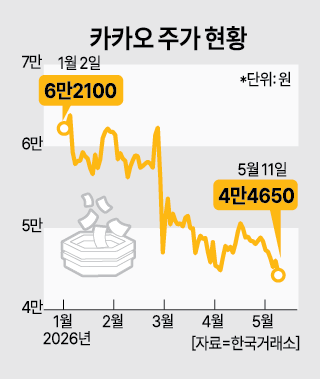
Kakao's union is set to demand bonuses as it prepares for collective action, following Samsung Electronics' union's call for a 10% bonus based on operating profit. This has intensified labor-management tensions in the industry. Unlike Samsung, which has seen its stock price reach record highs, Kakao's shares have plummeted to near yearly lows, raising concerns that the company is prioritizing bonus demands over enhancing corporate value.
On May 11, the KOSPI index surpassed 7,800, approaching 8,000, while Kakao's stock price has been stagnant, causing distress among shareholders. Over the past month, the KOSPI surged nearly 30%, yet Kakao's shares fluctuated between a closing high of 50,600 won and a low of 45,250 won. Even on the day Kakao reported its highest-ever quarterly results, its stock price fell.
The decline in Kakao's stock is attributed to uncertainties surrounding its future growth potential. Although the company achieved record quarterly results, the improvement in profitability was largely due to restructuring effects rather than organic growth. Excluding contributions from subsidiaries like Kakao Games and Kakao Healthcare has also altered its profit structure. Despite the record performance, concerns about slowing growth, uncertainties in its AI strategy, and underperformance in its content business have kept market expectations low.
In this context, the Kakao union argues that the company’s record performance warrants corresponding compensation and is moving forward with collective action. The Crew Union of the National Chemical Fiber Food Industry Labor Union plans to hold a rally on May 20 at Pangyo Station in Seongnam, Gyeonggi Province. The union will begin accepting participant registrations on that day or the following day. This rally is intended to mobilize members and raise public awareness if negotiations with management do not proceed smoothly.
Earlier, on May 7, the Kakao union declared a breakdown in wage and collective bargaining negotiations with management and submitted a mediation request to the Gyeonggi Regional Labor Relations Commission. This year's negotiations involve five subsidiaries, including Kakao, Kakao Pay, Kakao Entertainment, DK Tech, and XL Games.
The union maintains that given Kakao's record performance, appropriate compensation is necessary. However, it is reported that they are not demanding a specific percentage of operating profit like Samsung's union. Internally, there is a recognition that many subsidiaries are still operating at a loss, making it challenging to demand uniform bonuses tied to operating profit.
In shareholder communities and on Naver's stock discussion forums, reactions have emerged regarding the ongoing discussions about bonuses while the stock price remains low. Critics argue that internal compensation issues are being prioritized over restoring corporate value and returning profits to shareholders.
Some investors have expressed frustration, stating, "Samsung Electronics, despite its bonus discussions, has seen its stock price rise, while Kakao's union is only focused on bonuses without any stock rebound," and others have commented that "restoring corporate value should take precedence over bonuses." Additionally, some investors have noted, "There seems to be no clear growth drivers since the appointment of CEO Jeong Shin-ah," and have suggested that unless a new major service akin to KakaoTalk emerges, the potential for stock price increases may be limited.
Industry observers believe that the ongoing labor disputes at Kakao could influence wage negotiations across the broader IT sector, particularly in the platform and gaming industries, where demands for enhanced performance-based compensation may gain traction. However, with ongoing stock price declines and slowing growth, finding a balance between employee compensation and shareholder value remains a critical challenge for companies.
* This article has been translated by AI.
Copyright ⓒ Aju Press All rights reserved.