

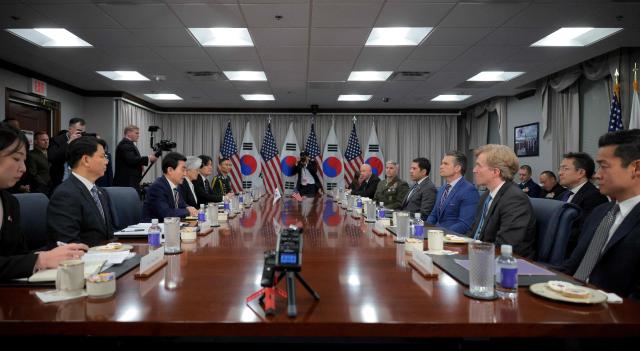
The talks between South Korean Defense Minister Ahn Gyu-back and U.S. Secretary of War Pete Hegseth at the Pentagon came as Washington intensifies calls for allies, including Seoul, to play a more proactive role in reopening the Strait of Hormuz following attacks on commercial shipping and escalating Iranian threats.
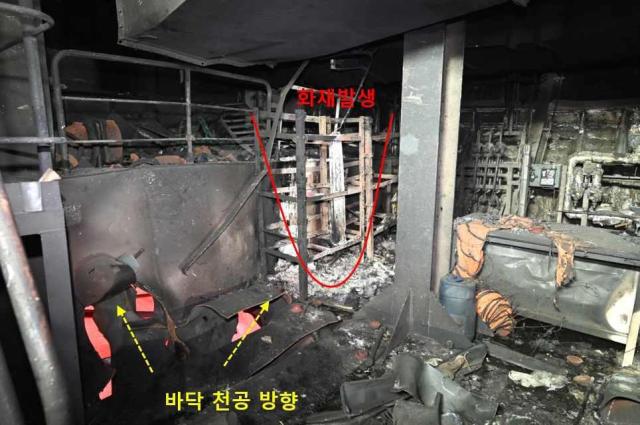
The backdrop to the meeting was the recent strike on the Korean-operated bulk carrier HMM Namu near Hormuz, which Seoul concluded was caused by an “external strike” involving unidentified airborne objects. While South Korea strongly condemned the attack and vowed a response, it has stopped short of publicly naming Iran as the perpetrator despite repeated pressure from U.S. President Donald Trump.
Hegseth used the Pentagon meeting to sharpen Washington’s message on burden-sharing and a greater South Korean security role within the alliance framework, linking the Korean Peninsula more directly to broader global security challenges.
“Our meeting today arrives at a pivotal moment for the U.S.-ROK Alliance,” Hegseth said in opening remarks. “Together, our nations are taking strong actions to ensure our combined readiness and to defend vital national security interests.”
Referring to the U.S. military campaign against Iran, dubbed “Operation Epic Fury,” Hegseth said the operation demonstrated “this administration's unwavering commitment to confronting threats and defending those interests.”
“In this current global threat environment, the strength of our alliance is critical, and we look to our partners to stand shoulder-to-shoulder with us,” he added.
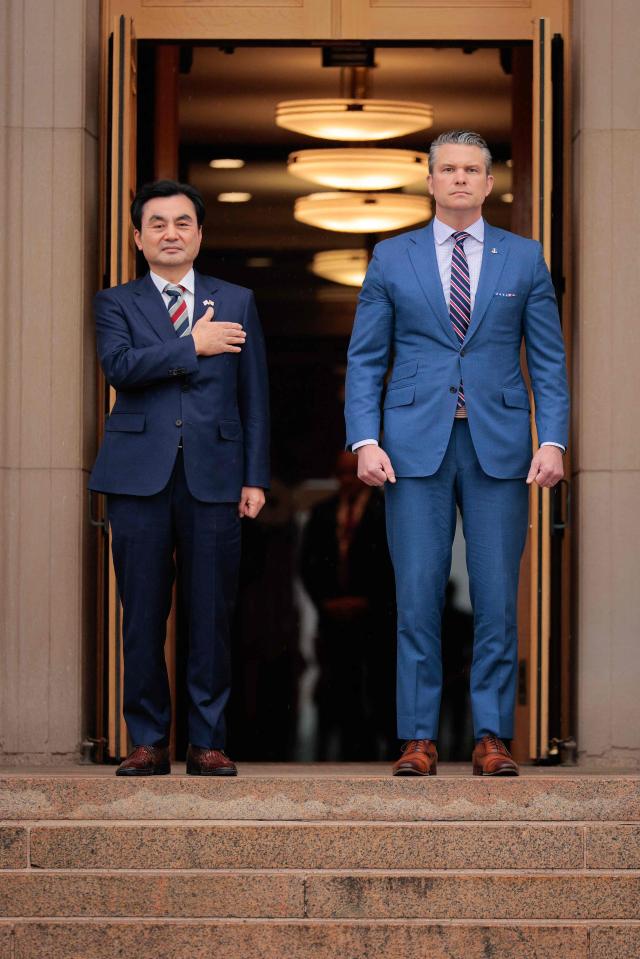
Hegseth also renewed pressure on Seoul over defense burden-sharing, praising South Korea’s pledge to raise defense spending and assume greater responsibility for peninsula security. The Pentagon later explained that greater allied burden-sharing forms one of the four core pillars of the 2026 U.S. National Defense Strategy alongside homeland defense, deterring China in the Indo-Pacific and strengthening the U.S. defense industrial base.
“As I noted during my visit to Seoul last November, Republic of Korea's commitment to increase defense spending and your leadership in assuming primary responsibility for the security of the Korean Peninsula is very important,” Hegseth said. “Real burden-sharing is the foundation of a resilient alliance, and it is essential for effectively deterring our mutual adversaries.”
Though the official Pentagon and Defense Ministry readouts did not explicitly mention Hormuz, officials in Seoul acknowledged the regional crisis and maritime security concerns formed part of the broader consultations surrounding Ahn’s Washington trip.
Seoul has so far attempted to calibrate its response carefully. The presidential office condemned attacks on civilian shipping as unacceptable and pledged continued participation in international efforts to ensure freedom of navigation, while avoiding direct attribution to Tehran pending further analysis.
That cautious approach reflects Seoul’s concern over being drawn deeper into a U.S.-Iran confrontation while still preserving close alliance coordination with Washington. South Korea remains heavily dependent on Middle Eastern crude imports and has historically sought to maintain working diplomatic channels with Iran.
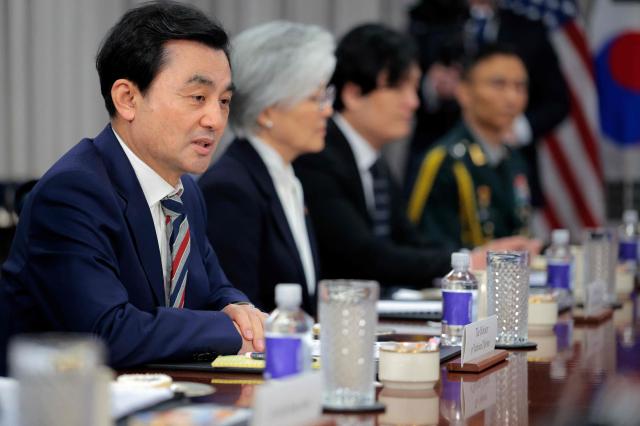
Ahn, while avoiding direct references to Iran, stressed alliance unity amid what he described as “difficult conditions.”
“Just because we get to see familiar faces today, it really epitomizes what an alliance truly is,” Ahn said. “It's a big honor to have such a good meeting between the two countries, despite the difficult conditions that we're facing today.”
At the same time, Seoul continued emphasizing its long-term objective of a more autonomous defense posture.
“We are also keeping pace, putting our utmost efforts into achieving a ROK-led defense of the Korean Peninsula by acquiring critical national defense capabilities through measures such as increasing defense spending,” Ahn said.
According to the joint readout, the two ministers discussed wartime operational control transition and “Alliance modernization,” while agreeing to strengthen cooperation moving forward.
The issue remains one of the alliance’s most sensitive fault lines. U.S. Forces Korea Commander Gen. Xavier Brunson recently referred to the first quarter of 2029 as a possible timeline for OPCON transition during congressional testimony, exposing differences in expectations between the allies. The Lee Jae Myung administration is understood to be seeking progress before the current administrations in Seoul and Washington end in 2028.
The ministers reaffirmed the importance of this week’s Korea-U.S. Integrated Defense Dialogue (KIDD) in Washington, describing it as a key mechanism for advancing alliance cooperation and national interests. The three-day meeting through Wednesday is being led by South Korean Deputy Defense Minister for Policy Kim Hong-cheol and U.S. Assistant Secretary of Defense for Indo-Pacific Security Affairs John Noh, with senior officials from both defense and foreign affairs agencies participating.
The KIDD agenda is expected to cover broader alliance security issues including OPCON transition, combined defense posture and alliance modernization.
“I believe this meeting is a significant opportunity to assess the achievements of the joint fact sheet between the presidents last year and the 57th Security Consultative Meeting, and to communicate about the alliance's direction moving forward,” Ahn said. “As a ROK-U.S. alliance has stood together upon a bedrock of unwavering trust even through hard times, we remain committed to close cooperation in the future in one voice.”
At the same time, Seoul expanded its defense outreach beyond the traditional alliance framework. South Korea and North Atlantic Treaty Organization held their second defense industry consultative meeting Monday as Seoul seeks to deepen coordination with Western partners amid growing links between Indo-Pacific and European security following the Ukraine war and Middle East instability.
The consultative body was launched after South Korea and NATO agreed during the 2025 NATO summit in The Hague to establish a working-level framework for defense industrial cooperation. The first session was held at NATO headquarters in Brussels in September last year.
At the second meeting held eight months later, the two sides shared information on potential cooperation areas and discussed concrete defense industrial collaboration. South Korea stressed that access to NATO standards was essential to improve interoperability of Korean weapons systems, while NATO requested Seoul’s participation in multilateral projects in areas such as ammunition and space cooperation.
DAPA Commissioner Lee Yong-chul said Seoul hopes to establish itself as “a reliable IP4 partner nation,” referring to NATO’s Indo-Pacific partners of South Korea, Japan, Australia and New Zealand.
He added that the Indo-Pacific and NATO security environments have become “more closely connected” following Russia’s war in Ukraine and pledged continued coordination with NATO’s international staff to develop concrete cooperation frameworks.
The NATO delegation’s visit followed a trip last month by ambassadors from 30 NATO member states to South Korea, during which they toured major defense firms including HD Hyundai Heavy Industries and Hanwha Aerospace, underscoring growing European interest in South Korea’s defense manufacturing capabilities.
Copyright ⓒ Aju Press All rights reserved.
