

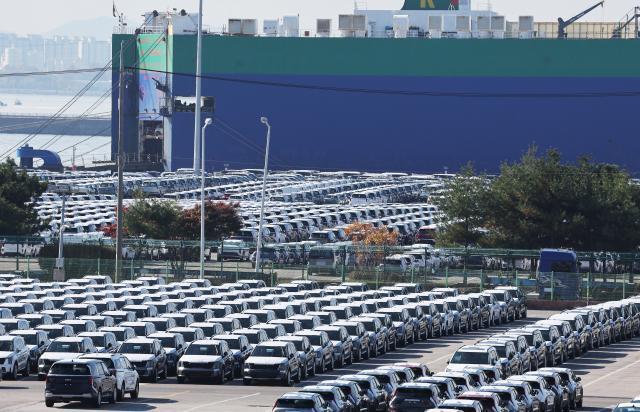
According to the Korea Automobile Mobility Industry Association (KAMA), as of last month, a total of 76,548,569 vehicles have been exported. This record comes 50 years after Hyundai Motor Company exported its first domestic passenger car, the Pony, to Ecuador in June 1976.
Korean automobile exports surpassed the 10 million mark for the first time in 1999, with 11,073,814 vehicles shipped. The rise of Hyundai and Kia as top-tier global automotive brands has significantly elevated the status of the Korean automotive industry.
Since then, exports have increased by approximately 10 million units every three to four years, with figures of 51,098,839 in 2015, 61,093,781 in 2019, and 70,087,640 in 2023. Industry insiders suggest that if the current trend continues, cumulative exports could exceed 80 million next year.
As competition intensifies in the global market, the automotive sector continues to expand. A recent report from HMG Strategy Institute forecasts that the global automotive market will grow by 0.2% year-on-year to approximately 87.93 million units. While growth in advanced markets like the U.S. and Western Europe is expected to slow, emerging markets such as India are anticipated to gain momentum.
The domestic automotive production sector also reached a historic milestone this year. Cumulative production, which totaled 129,110,000 vehicles last year, surpassed 130 million with an additional 1,387,043 units produced from January to April this year.
The highest honor, the Gold Tower Industrial Medal, was awarded to Jae-hoon Chang, Vice Chairman of Hyundai Motor Group. The Silver Tower Industrial Medal went to Sang-sik Ham, CEO of MR Infra Auto, while the Bronze Tower Industrial Medal was awarded to Ki-young Hwang, CEO of KG Mobility.
This year's awards focused on individuals who have strengthened the competitiveness of future vehicles through initiatives such as attracting domestic production of eco-friendly cars, technological development, innovations in AI, software, and autonomous driving technologies, advancements in smart manufacturing, building a future vehicle industry ecosystem, and exploring new markets through cooperative efforts.
Jung Dae-jin, President of KAMA, stated, "The 50 years of automotive exports reflect the history of South Korea's economic growth. To maintain our lead in the global future vehicle competition, we need to secure domestic production bases and expand research and development and investment through public-private cooperation."
* This article has been translated by AI.
Copyright ⓒ Aju Press All rights reserved.