

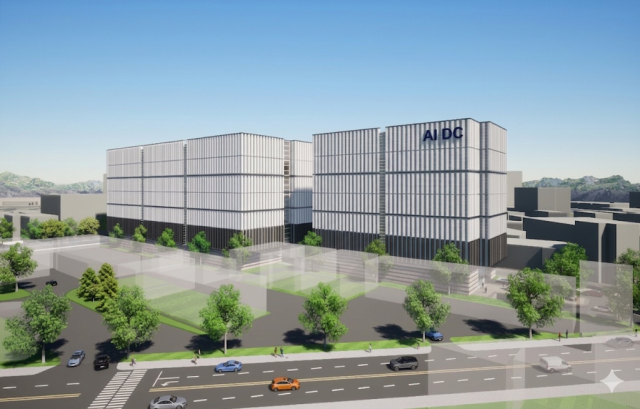
The Special Act on the Promotion of the Artificial Intelligence Data Center (AIDC) industry passed the National Assembly on May 7, drawing attention to Article 20, which allows direct trading of renewable energy. This provision enables AIDC operators to enter power purchase agreements (PPAs) directly with renewable energy producers, bypassing Korea Electric Power Corporation (KEPCO). The government aims to address the chronic issue of power procurement for AIDCs through renewable energy. However, industry reactions have been lukewarm.
On May 14, multiple sources from domestic AIDC operators and construction firms expressed skepticism, stating that "direct trading of renewable energy is a provision that institutionalizes losses under the current structure." They criticized the legislation for not considering the critical role of electricity procurement costs in the operational profitability of AIDC businesses.
AIDCs are extremely power-intensive facilities, consuming dozens of times more electricity than typical office buildings. Hyper-scale data centers require over 100MW of continuous power supply around the clock. Electricity costs account for 40-50% of total operating expenses, with AIDCs facing even higher burdens due to their power density.
Operators calculate their break-even points differently based on size, but on average, small AIDCs under 40MW find profitability at around 150 won per kWh, while hyper-scale AIDCs over 100MW reportedly face losses if costs exceed 220 won per kWh.
The problem is that the current market price for renewable energy in South Korea far exceeds these break-even points. According to industry sources, the current direct trading price for renewable energy, including solar power, is around 250 won per kWh, with offshore wind exceeding 300 won. In direct trading, prices are negotiated between suppliers and consumers, leading to increases of over 100 won per kWh compared to generation costs.
The Korea Energy Economics Institute estimates the levelized cost of electricity (LCOE) for solar power in South Korea at 122 won per kWh and offshore wind at 238 won as of 2024. The actual supply prices are higher than the LCOE due to additional costs such as renewable energy certificates (RECs), grid connection fees, and backup power costs to address intermittency.
South Korea's solar LCOE is reported to be 2.1 to 2.5 times higher than the global average, while onshore wind is about three times higher, and offshore wind is 1.3 to 2.4 times higher than in major countries.
An official from an AIDC construction firm stated, "The moment we sign a renewable energy PPA, we confirm operational losses due to electricity costs. Even if global tech giants like Google and Microsoft enter Korea, they cannot achieve profitability under the current renewable energy supply prices."
In the current landscape, AIDC operators see nuclear power as a realistic alternative. The current cost of nuclear power is around 60 to 80 won per kWh, significantly lower than renewable energy prices, at about one-third to one-fourth of the cost.
However, Article 20 of the AIDC law only specifies direct trading of renewable energy. There is no provision for AIDC operators to purchase nuclear power directly, nor is there any law facilitating the supply of nuclear electricity. Nuclear power can still only be obtained through KEPCO, which applies its industrial electricity pricing structure. According to the Korea Energy Economics Institute, it is estimated that renewable energy will not reach the AIDC break-even point until after 2050.
An industry source remarked, "The most suitable power source for AIDCs is stable nuclear energy supplied 24/7, yet the law only opens the door for direct trading of renewable energy. This provision is disconnected from reality for both global tech giants needing to meet RE100 requirements and domestic AIDC operators."
* This article has been translated by AI.
Copyright ⓒ Aju Press All rights reserved.