The conflict in the Middle East is unraveling the global garment industry, proving that fast fashion is as much a byproduct of crude oil as it is of cotton.
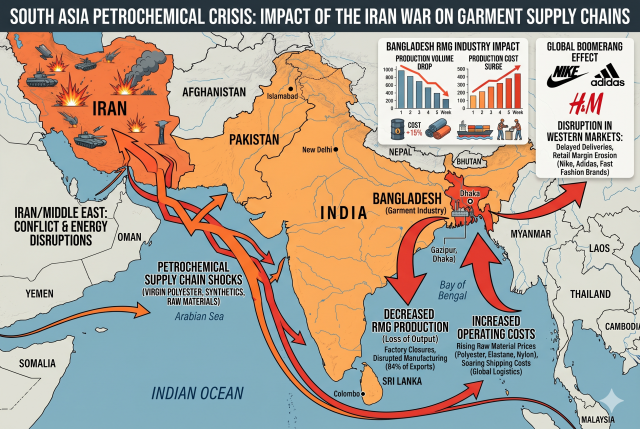
In the industrial sprawl of Gazipur, just north of Dhaka, the looms of the world’s second-largest apparel engine are beginning to stutter. For decades, the floor managers of these vast, vertically integrated factories have calculated their margins down to the fraction of a cent. They optimized for labor, they maximized volume, and they built an empire that churns out billions of garments a year for Western retail racks. But today, the crisis halting production does not originate on the factory floor or in the cotton fields of the subcontinent. It originates thousands of miles away, in the contested waters and oil fields of the Middle East.
When geopolitical friction flares in the Persian Gulf, the immediate panic in Western capitals predictably centers on crude oil and gasoline prices at the pump. This is a remarkably narrow lens. Viewed from the industrial hubs of Asia, a far more structural friction is playing out in the cargo holds and ledgers of the global apparel industry. We have conditioned ourselves to view clothing as a soft, agricultural product, spun from nature and stitched by human hands. We forget that the modern wardrobe is fundamentally a petroleum byproduct, and current geopolitical shockwaves are exposing the terminal fragility of that reliance.
Ready-made garments constitute nearly 85 percent of Bangladesh's total export earnings, forming the absolute bedrock of the nation's economy. Yet the synthetic fibers required by the original equipment manufacturers that supply global athletic and fast-fashion brands—the polyesters, nylons, and elastanes that dominate modern activewear—are derived directly from petrochemicals. Polyester alone accounts for nearly 59 percent of global fiber production. As regional instability threatens the supply of essential feedstocks, the cost of these synthetic materials is surging, turning a distant standoff into a direct assault on South Asia's industrial lifeblood.
A logistical nightmare compounds the squeeze on Dhaka. With crucial maritime corridors fraught with war risk, global shipping lines have rerouted vessels around the Cape of Good Hope. This geographic detour adds 20 to 25 days to transit times and has pushed freight rates for a standard container heading from Asia to Europe upward of $4,500. Factory owners are now caught in a vice. They are paying a severe premium to import the synthetic feedstock required for production, and they are bleeding capital to export the finished goods to ports in the European Union and the United States.
It is tempting for Western consumers to view this as a localized economic misfortune for a developing nation. That is a naive misreading of a deeply integrated supply chain. The peril facing Bangladesh is already beginning to boomerang back to the corporate headquarters of the world’s largest fashion conglomerates. Companies that rely heavily on South Asian manufacturing have built their business models on the assumption of cheap, uninterrupted production. With an estimated 70 percent of sneaker materials alone relying on oil-based inputs, the illusion of insulated Western retail margins is collapsing under the weight of soaring energy costs, inflated shipping premiums, and delayed deliveries.
This margin collapse may inadvertently trigger the very structural shift the industry has long resisted. For years, Western brands have treated sustainable practices and recycled materials as a marketing luxury rather than a supply chain necessity. But as virgin polyester becomes prohibitively expensive and logistically perilous to source, necessity is forcing a pivot. The energy shock is accelerating investments in circular manufacturing and recycled synthetics—not out of a sudden onset of corporate altruism, but as a ruthless survival mechanism to decouple their product lines from the volatility of crude oil.
The era of hyper-efficient, borderless fast fashion was an anomaly subsidized by global stability and cheap petroleum. As the fault lines of the Middle East fracture the logistics and raw materials required to dress the West, the illusion of cheap clothes is unraveling. We are finally discovering the true cost of outsourcing our production to a system that shatters the moment a shipping lane closes.

Copyright ⓒ Aju Press All rights reserved.