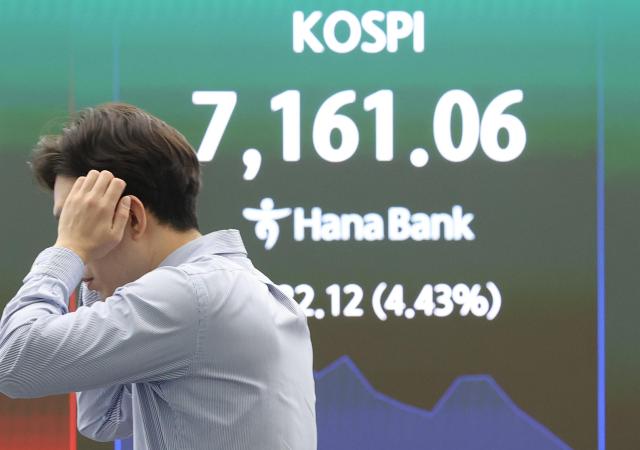
The drop, the lowest since May 4, came as investors reacted to a global technology selloff and rising U.S. bond yields, while uncertainty over Samsung Electronics' ongoing labor dispute added further pressure.
The index opened down 0.67 percent at 7,443.29 points before extending losses and falling as low as 7,142.71 in early trade, a drop steep enough to trigger a sell-side sidecar at 9:19 a.m. amid a simultaneous plunge in KOSPI 200 futures.
The selloff came after the yield on the benchmark 10-year U.S. Treasury note climbed to as high as 4.60 percent on Friday, its highest level in roughly 15 months, fueling concerns that persistent inflation could keep interest rates elevated for longer than markets had expected.
The junior KOSDAQ also slipped 4.29 percent to 1,081.30, while the South Korean won weakened slightly to 1,504.20 per dollar from 1,500.80 in the previous session.
The decline also followed sharp losses on Wall Street late last week, where the Nasdaq fell 1.54 percent and semiconductor shares slid sharply as rising Treasury yields pressured technology stocks.
Oil prices also rose sharply amid concerns over prolonged disruptions around the Strait of Hormuz, adding to worries that inflation could remain stubbornly high. Brent crude futures settled up 3.4 percent at US$109.26 a barrel, while U.S. West Texas Intermediate crude climbed 4.2 percent to $105.42.
U.S. President Donald Trump's summit with Chinese President Xi Jinping also did little to calm markets, as the two leaders ended talks without concrete progress on broader geopolitical tensions involving Iran and Gulf countries including the Strait of Hormuz.
The global semiconductor selloff spilled directly into Seoul, where Samsung Electronics traded at 270,000 won, down 0.18 percent, while SK hynix fell 3.13 percent to 1,762,000 won as investors pulled back from AI-linked chip stocks.
Samsung Electronics has been facing growing labor tensions after its union threatened a strike later this week following a breakdown in wage negotiations. The union has been demanding higher incentives and the removal of caps on performance bonuses in proportion to the company's strong operating profits in its chip division amid an artificial intelligence (AI)-driven semiconductor supercycle.
Investors worry that the electronics giant's prolonged dispute could raise labor costs or disrupt semiconductor production at a time when global AI demand remains heavily concentrated in advanced memory chips. The impending strike has added to uncertainty on the South Korean bourse, as semiconductors make up a large share of the country's exports and Samsung dominates it by market capitalization, leaving the sector especially sensitive to both global demand shocks and domestic labor risks.
Losses spread broadly beyond semiconductors. Among major technology and industrial shares, Samsung SDI fell 4.95 percent to 960,000 won, LG Energy Solution dropped 5.52 percent to 394,000 won and Doosan Enerbility slid 5.96 percent to 104,200 won.
Automakers also came under pressure, with Hyundai Motor falling 7.43 percent to 648,000 won and Kia declining 4.94 percent to 159,700 won.
Defense and shipbuilding-related shares weakened as well, with HD Hyundai Heavy Industries dropping 7.34 percent to 593,000 won and Hanwha Aerospace slipping 1.15 percent to 1,202,000 won.
Financial and biotech shares also moved lower, as KB Financial fell 3.08 percent to 150,800 won, Samsung Biologics declined 3.88 percent to 1,364,000 won and Samsung C&T dropped 5.04 percent to 376,500 won.
Losses were equally broad on the KOSDAQ, where secondary-battery, biotech and robotics shares all traded sharply lower. Among battery-related stocks, EcoPro BM fell 2.57 percent to 185,600 won, while EcoPro dropped 5.26 percent to 122,400 won. Robotics firm Rainbow Robotics plunged 9.26 percent to 735,000 won, and aerospace company Korea Aerospace Industries slipped 3.76 percent to 107,400 won.
Biotech shares also weakened, with Alteogen falling 5.42 percent to 349,000 won, Samchundang Pharm declining 7.47 percent to 359,000 won, HLB dropping 5.30 percent to 49,150 won and ABL Bio sliding 8.55 percent to 109,100 won. Jusung Engineering stood out as the only major gainer, surging 21.04 percent to 169,700 won.
Despite the broad selloff, investors appear to remain on watch for upcoming catalysts that could shape the direction of AI-related semiconductor stocks.
Nvidia is scheduled to report earnings results later this week, with markets closely watching whether the chipmaker can beat revenue forecasts of $78 billion and achieve a gross margin of 75 percent. Also in focus will be management's comments on demand from China, after Washington recently approved the sale of H200 chips to the country.
Investors also remain attentive to developments in Nvidia's next-generation Blackwell chips and the timeline for its Rubin architecture, given the implications for South Korean suppliers such as Samsung Electronics and SK hynix.
Elsewhere in Asia, markets moved lower as investors reacted to rising global bond yields and persistent inflation concerns. Japan's Nikkei 225 fell 1.40 percent to 60,547.46, pressured by profit-taking in semiconductor shares, Hong Kong's Hang Seng Index dropped 1.06 percent to 25,687.49 and China's Shanghai Composite Index also edged down 0.19 percent to 4,127.62.

Copyright ⓒ Aju Press All rights reserved.