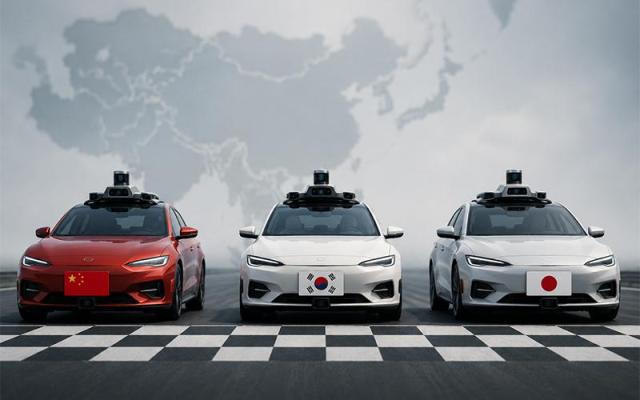
China is rapidly scaling up commercial robotaxi fleets while Japan has unlocked Level 4 services on public roads. Modest in comparison, Hyundai Motor Group is launching a citywide testbed in Gwangju to close the gap with overseas rivals.
Speaking to reporters last week at the group’s headquarters in southern Seoul, Hyundai Motor Group Chairman Chung Eui-sun openly acknowledged the gap but signaled that Hyundai would not chase speed at any cost.
"Autonomous driving is being pushed very quickly by China and Tesla," Chung said, admitting "Waymo is also doing well."
"Technology can make up for what is lacking, but the most important thing is safety," he added, suggesting Hyundai would not be matching rivals in speed.
In any fledgling market, moving first has its advantages. The global autonomous driving market is projected to grow from $286.45 billion in 2026 to about $3.03 trillion by 2033, according to Coherent Market Insights.
Goldman Sachs Research separately estimates the broader autonomous vehicle sector could generate roughly $2 trillion in annual revenue by 2035, with the global commercial robotaxi fleet expanding from around 7,000 vehicles in 2025 to some 6 million by 2035.
China leads the Asian pack.
Baidu’s Apollo Go now operates in 27 cities globally, with weekly rides peaking at more than 350,000 in March, and is expected to begin testing robotaxis in London alongside Uber and Lyft.
WeRide has expanded into Singapore and the Middle East, while Mercedes-Benz-backed Momenta is rolling out robotaxis on Uber’s network in German cities.
Japan is moving less aggressively, but visibly nonetheless.
The country revised its Road Traffic Act in April 2023 to permit Level 4 driving on public roads under prefectural public safety commission oversight, paving the way for pilot services by Honda Motor, Nissan, Toyota Motor and open-source platform developer Tier IV.
Eiheiji Town in Fukui Prefecture launched the country’s first Level 4 public-road service in May 2023, and Tier IV completed robotaxi pilot tests in Tokyo’s Odaiba and Nishi-Shinjuku districts in late 2024.
Korea, despite its technology and manufacturing capacity, is still taking its time.
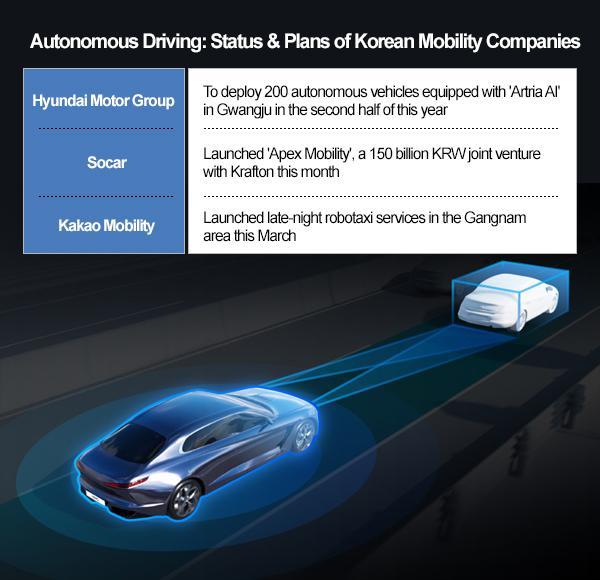
The Gwangju pilot is Seoul’s most ambitious response to date, with the southwestern city last month becoming the first major Korean municipality to designate its entire road network as a Level 4 testbed. Hyundai plans to deploy 200 self-driving vehicles equipped with eight cameras and one radar in the second half of this year.
The Gwangju fleet will run on Atria AI, an in-house autonomous driving stack developed by Hyundai subsidiary 42dot. Hyundai is also weighing adoption of Alpamayo, the open-source reasoning vision-language-action model unveiled by Nvidia at CES 2026, although no formal partnership has been announced.
In January, the group named Park Min-woo — a self-driving specialist who previously worked at Tesla and Nvidia — as chief executive of 42dot and head of its Advanced Vehicle Platform division.
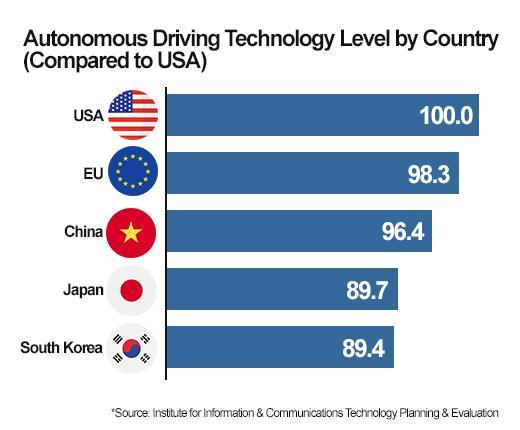
The Board of Audit and Inspection, in a 2024 review of Korea’s response to the Fourth Industrial Revolution, said inter-ministerial disputes had delayed government decisions on autonomous driving for an extended period, widening the technology gap with overseas rivals.
Yet Hyundai’s safety-first posture, echoed by domestic researchers, points to what some experts see as Korea’s potential differentiator.
While the country may trail Tesla’s accumulated driving data and the centralized push of China’s state-backed champions, Korean academics argue the local industry is steering its AI training toward courtesy, caution and respect on the road — a "warmer" model of autonomy that could carve out a distinct niche.
"Aggressive driving is something an autonomous AI can also learn," said Lim Yong-seob, professor of robotics and mechatronics engineering at the Daegu Gyeongbuk Institute of Science and Technology.
"AI prioritizes goal completion above all, so it may follow user commands absolutely and even adopt dangerous driving methods to save time, sidelining humans and triggering collisions as vehicles compete for resources with other autonomous cars," Lim said.
"Research actually shows that cooperative autonomous driving with frequent yielding can sharply cut collision rates, even at the cost of slightly slower travel. A conservative, human-protecting style of autonomy — one that errs on caution in rain or unusual conditions — will become increasingly important."
For Seoul, the next 18 months in Gwangju may determine whether South Korea can claw back lost ground — or watch the next great mobility platform be built largely in Beijing, Tokyo and Silicon Valley.
Copyright ⓒ Aju Press All rights reserved.