

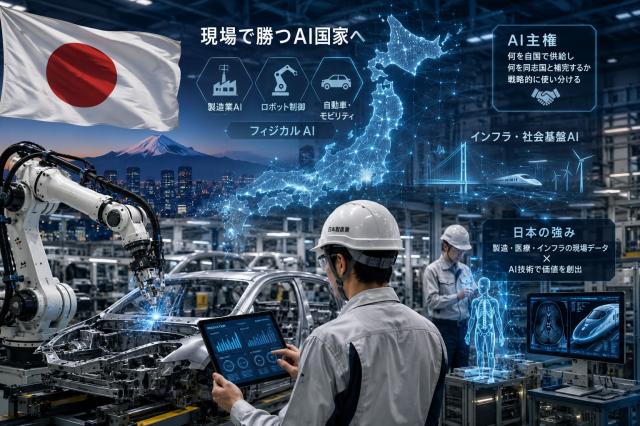
Japan's political landscape is changing its perspective on artificial intelligence (AI). Instead of the rallying cry of "catching up to the U.S. and China," a more pragmatic approach has emerged, focusing on areas where Japan can excel. This shift is symbolized by recent AI policy proposals from the ruling Liberal Democratic Party (LDP), which emphasize that "complete domestic production of AI across all fields is neither realistic nor strategic."
Historically, Japan has been known for its strong nationalist tendencies, striving for self-sufficiency in sectors like semiconductors, operating systems, and mobile phones. However, this approach has led to harsh realities, as Japan's platforms, disconnected from global standards, have fallen behind in international competition. The term "Galapagosization" is often used in Japanese industry to describe this failure. The current AI strategy signals a commitment to avoid repeating past mistakes.
Notably, the Japanese government and the LDP have effectively stepped back from competing in the development of a "Japanese version of ChatGPT." Initially, the Ministry of Economy, Trade and Industry aimed to invest government funds into developing a large-scale language model (LLM) unique to Japan. However, strong internal opposition within the LDP argued that pursuing this with limited resources against the U.S. and China was reckless. Consequently, the government has essentially abandoned its goal of developing a large foundational model.
Japan's decision appears pragmatic when considering the current landscape of generative AI, which is dominated by the U.S. and China. Companies like OpenAI and Google in the U.S., along with Baidu and DeepMind in China, operate with astronomical capital, data, and semiconductor infrastructure. Between 2019 and 2023, Japan's AI investment was approximately $10 billion, while the U.S. invested $329 billion and China $133 billion, highlighting a significant disparity.
Instead, Japan is pivoting towards areas where it has strengths, such as manufacturing, healthcare, robotics, and infrastructure control—collectively referred to as "field-based AI." The emphasis on physical AI has emerged from this focus, indicating a commitment to developing AI that can operate in factories, hospitals, and with vehicles and robots, rather than merely conversational AI.
This strategy aligns closely with Japan's industrial structure. The country still possesses some of the world's best manufacturing data, with decades of accumulated information from automotive factories, precision machinery, and industrial robotics. While U.S. companies excel in platform and software competitiveness, Japan holds a wealth of data on actual industrial processes and production. The strategy is to exploit this niche.
Interestingly, Japan is beginning to view AI not just as a technological competition but as a matter of economic security. The LDP's recent proposals even included the term "AI sovereignty." However, this does not imply a complete push for domestic production. Instead, it suggests a strategic distinction between what Japan will control directly and what it will collaborate on with allied nations.
This approach resonates with Japan's long-standing practical industrial strategy. By cooperating with U.S. technology while retaining control over revenue-generating structures and core data, Japan aims to apply the same logic to AI.
Underlying this shift is a sense of urgency within Japanese society. The country's digital deficit has ballooned to approximately 5 trillion yen (about $50 billion) annually, with cloud services, software, and platform fees predominantly flowing overseas. There is a strong concern that increased reliance on American platforms for AI could push Japanese industries into an "AI subcontracting structure."
As a result, Japan is moving closer to the goal of "surviving as a manufacturing powerhouse in the AI era" rather than striving to create the world's best generative AI. While stepping back from the flashy generative AI competition, Japan is determined to maintain its leadership in the industrial sectors of factories, hospitals, vehicles, and robotics. This may well be the most authentically Japanese strategy for AI survival that the country has chosen today.
* This article has been translated by AI.
Copyright ⓒ Aju Press All rights reserved.