

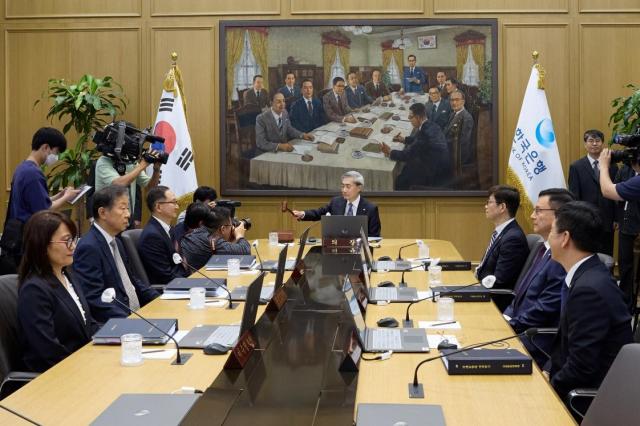
The Bank of Korea has kept its benchmark interest rate steady for the eighth consecutive time. The central bank raised its economic growth forecast significantly, citing a semiconductor boom, while also adjusting its inflation expectations due to the ongoing Middle East conflict.
During a monetary policy meeting on May 28, the Bank of Korea's Monetary Policy Committee decided to maintain the benchmark interest rate at 2.50%. This marks the eighth consecutive month of holding the rate steady, following similar decisions in July, August, October, and November of last year, as well as January, February, and April of this year.
The decision to hold rates was influenced by better-than-expected economic performance and the prolonged conflict in the Middle East. On this day, the Bank of Korea revised its real GDP growth forecast for this year to 2.6%, up from previous estimates. The forecast for next year was also raised to 2.1%, compared to earlier projections of 2.0% for this year and 1.8% for next year made in February.
Earlier this year, South Korea's economy achieved a surprising growth rate that exceeded the Bank of Korea's initial estimate of 0.9%. In the first quarter, GDP growth reached 1.7%, driven largely by the semiconductor sector. As a result, there are indications that exports could reach $900 billion this year.
The ongoing conflict in the Middle East has also played a role in the central bank's monetary policy decision. In April, the Monetary Policy Committee noted the significant uncertainties posed by the conflict and decided to maintain the current interest rate while monitoring the situation.
Inflationary pressures are rising due to the Middle East conflict. Consequently, the Bank of Korea has adjusted its consumer price inflation forecast for this year to 2.7%, an increase of 0.5 percentage points from previous estimates. The inflation forecast for next year was also raised from 2.0% to 2.3% compared to the February outlook.
The exchange rate has remained around 1,500 won. As of 10:15 a.m. on this day, the won-dollar exchange rate was 1,503.8 won. The ongoing difficulties in ceasefire negotiations in the Middle East have heightened the preference for safe-haven assets, with the exchange rate maintaining the 1,500 won level for nine consecutive trading days since May 15.
* This article has been translated by AI.
Copyright ⓒ Aju Press All rights reserved.