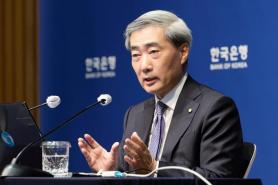
The central bank kept its policy rate at 2.5 percent, a decision nearly every economist had expected, at the first meeting chaired by new BOK governor Shin Hyun-song. The news lay in the dissent: five of the seven board members voted to hold while two pushed for an immediate increase, a rare split that underscored how quickly the policy mood has shifted. The board's own projections now lean toward lifting the rate to 3 percent within six months, with two members signaling it could rise further, toward 3.25 percent.
The benchmark KOSPI fell about 0.5 percent to close at [CLOSE], retreating from Wednesday's record of 8,228.70, while three-year government bond futures turned sharply lower after the announcement, erasing earlier gains. Most analysts now expect a quarter-point increase as soon as July, with a second move later in the year — a decisive turn away from the low-rate policy of recent years.
Behind the shift is a single chain of pressure. The conflict in the Middle East has driven oil prices higher over recent months, and a won that has weakened several percent against the dollar this year has amplified the effect, effectively importing inflation. The bank raised its inflation forecast for this year to nearly 3 percent and lifted its growth outlook to around 2.5 percent, citing the oil spillover. Higher rates, Governor Shin stressed, are needed both to contain broadening price pressure and, in part, to defend the currency — the weaker the won, the costlier the imported energy feeding inflation.
Notably, the rate signal did little to dent the chipmakers that have led the market's run, leaving the broader test of the rally still ahead. SK hynix closed up about 2 percent near 2.29 million won, holding above the $1 trillion market-capitalization mark it crossed for the first time a day earlier, as global demand for high-bandwidth memory tied to artificial intelligence keeps its capacity fully booked. Samsung Electronics, by contrast, fell more than 2 percent to 299,500 won — a divergence between the two leaders on the same day that points to a rally driven by stock-specific demand rather than a uniform tide. Doosan Robotics, which had risen in recent sessions as investors rotated out of the heavyweights and into the wider AI value chain, gave back about 2.5 percent to near 100,400 won.
On the main Seoul bourse, foreign investors remained net sellers, extending a selling streak that reached [14/15] consecutive sessions, taking profit after a rally that has nearly doubled the index this year, while domestic individuals and institutions continued to provide the offsetting demand that has sustained the market through the run.
Market breadth, though still narrow, was less lopsided than Wednesday, when only 77 stocks advanced against 826 declines on the main board even as the index set a record — a sign the rally may be beginning, tentatively, to widen beyond its semiconductor core. The junior KOSDAQ underperformed the main board, weighed by weakness across smaller growth shares.
Elsewhere in Asia, Japan's Nikkei 225 closed down nearly 0.5 percent at around 64,693, easing from record territory as investors positioned ahead of the Bank of Japan's mid-June policy meeting, now widely seen as the likely moment for its next rate increase. China bucked the regional trend, the Shanghai Composite edging up around 0.25 percent to close near 4,103, led by a near 6 percent jump in SMIC, the country's largest chipmaker, on optimism over China's drive for domestic chip self-sufficiency.
The Korean won eased to around 1,504 against the dollar, weaker than Wednesday's close near 1,500.9 and consistent with the strain the central bank cited in justifying a tighter path. Oil, the source of the inflation pressure behind the day's decision, remained the key external variable.
The regional picture is one of central banks diverging. Korea and Japan are both edging toward tighter policy, while China leans the other way in search of growth. For Korea, the message of the day is that the era of cheap money is ending — and a path toward 3 percent rates will test the chip-driven rally that has powered the market all year, pressuring the lofty valuations behind it even as a firmer won reshapes the calculus for the foreign investors who have lately been selling.
Copyright ⓒ Aju Press All rights reserved.