Surge in Abalone and Flounder Exports Boosts Fisheries in Japan
by Yujin KimPosted : June 1, 2026, 18:24Updated : June 1, 2026, 18:24
Share
facebook
twitter
URL
Text size
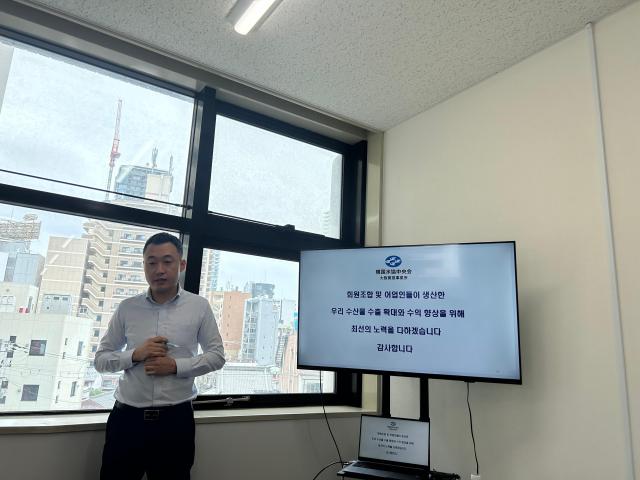
Kim Dong-hee, head of the Korea Fisheries Association's Osaka office, explains the office's status to a visiting press group. [Photo by Kim Yoo-jin]
"We aim to enhance the income of Korean fishermen by expanding the export of seafood products. Since our opening last March, we have achieved export results totaling 5.5 billion won," said Kim Dong-hee, head of the Korea Fisheries Association's Osaka office, during a meeting in Osaka on May 28.
The Osaka office represents more than just a foreign branch; it serves as a 'local direct distribution platform.' Moving away from a reliance on private exporters, the association has established its own distribution network in Japan.
Osaka is a major hub for seafood consumption in Japan, conveniently located near large cities like Kyoto, Kobe, and Nara, making it advantageous for securing significant consumer markets. The association has chosen Osaka as its first overseas office to develop a supply base for K-seafood in western Japan.
Since its opening on March 18 of last year, the Osaka office has focused on exporting live abalone and flounder. Previously, Korean seafood had to go through intermediaries or local wholesalers before reaching the market. Now, the association manages the entire process—from production to export to local distribution—ensuring the freshness of the seafood.
The office is collaborating with York Benimaru, a prominent Japanese distribution market, to supply seafood products and has confirmed exports of frozen abalone and salt. Additionally, efforts are underway to develop new products tailored to buyer demands, such as flower crabs.
From March to December last year, the office exported 3.8 billion won (180 tons) of live abalone and 1.3 billion won (60 tons) of live flounder, totaling 5.5 billion won in exports, while also diversifying its key products to include frozen abalone and live octopus.
These achievements were not easily attained. The Japanese market has high barriers for new entrants due to its established relationships. Kim shared, "I approached buyers as if I were hitting the ground running, making calls and visits to find potential partners." The sales efforts involved sending emails to import buyers and arranging meetings with those who responded.
Kim noted, "Once we meet, I feel confident. When I introduce our organization as similar to the National Federation of Fisheries Cooperatives in Japan, trust begins to build with buyers. Once mutual understanding is established, we can start transactions."
There is a growing interest among Japanese consumers in Korean abalone. Kim stated, "Farmed abalone from Korea is regarded as top quality and is a must-have in high-end restaurants for dishes like teppanyaki and butter-grilled abalone."
The Korea Fisheries Association is also accelerating the process of incorporating the Osaka office as a local entity. The association believes that formal incorporation will further contribute to diversifying exports.
Kim explained, "Once we are incorporated, we hope to expand our network to include small-scale businesses that want to import Korean seafood but are currently unable due to their size. This will enhance the diversification of Korean seafood exports. We are also considering storage facilities like tanks."
However, the increasing competition in the abalone market poses a challenge. In 2017, Japan imported between 1,600 and 1,700 tons of abalone, but this figure surged to 2,500 tons last year. This influx has led to a decline in abalone prices.
Kim remarked, "Intense internal competition within the Korean aquaculture industry has resulted in overproduction, which is driving down export prices. I understand that some regions are even beginning to reduce their aquaculture operations as a means of addressing this issue."