

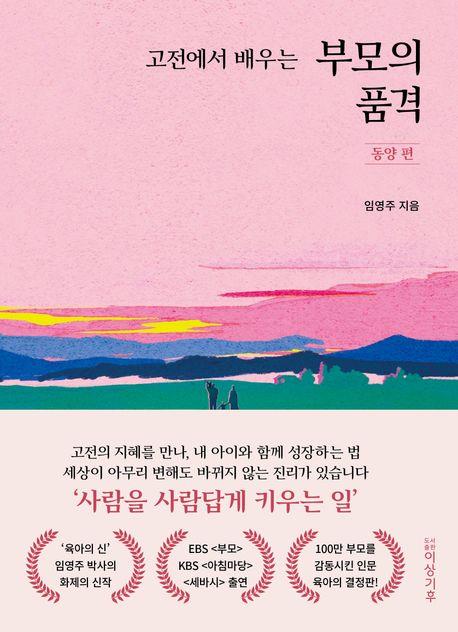
Parenting Dignity from Classical Wisdom = Im Young-joo, author, and Lee Sang-ki-hu.
The author, an education expert, has spent over 30 years counseling parents and has deeply felt the significant impact of parental words and attitudes on children's development. He emphasizes the importance of "raising a person to be a person" and offers solutions for applying the wisdom found in classical literature to modern parenting. Insights from Eastern classics, such as those by Mencius and Confucius, are presented as the most practical and useful principles for a child's holistic growth.
The book introduces classical texts, interprets their meanings, and provides real-life parenting examples along with specific practical strategies. Following concise and clear explanations of the classics, it presents advice applicable to common situations parents face. It covers various topics, including communication with children, responding to problematic behaviors, and discipline, bringing the teachings of the classics into everyday life.
Notably, the book illustrates the core of being a "dignified parent" through diverse examples, such as the concept of "Nandeuhodo" (the difficulty of being muddled), which encourages parents to allow children to realize things on their own instead of intervening excessively. It also discusses "Cheok-eunji-sim" (the heart of compassion), which suggests that if a child has already recognized their mistake, parents should first approach them with empathy. Additionally, it highlights "Bunsan-nan" (the difficulty of angry thoughts), which prompts parents to consider how their words might affect their relationship when feeling upset.
The book provides convincing answers for parents who wonder, "Do I really need to understand my child's feelings?" It clearly explains why it is essential to listen to children until they finish speaking, to consider their perspectives, and to manage emotions while disciplining.
This book serves as a guide for both parents and children to grow together. It teaches parents how to communicate in a way that children can understand and how to practice patience and wait, helping children naturally learn about relationships, emotional regulation, and dignified behavior by observing their parents. At the same time, it encourages parents to reflect on their inner selves and strengthen their own character.
For those who hope their children will remember, "I was respected as a person" when recalling memories with their parents, this book is worth reading. Each chapter includes a "Copybook" and "Applying to My Parenting Situation" sections, allowing readers to write, reflect, and apply the wisdom of the classics to their lives.
"The principle emphasized by Confucius, 'Do not impose on others what you do not desire for yourself,' applies equally to parent-child relationships. It means that parents should not subject their children to behaviors they would never want to experience themselves, such as verbal abuse or coercion. Being a parent does not exempt one from this rule. If someone speaks harshly to us, it can hurt our feelings and shake our self-esteem. Of course, it is part of a parent's role to teach rules and point out mistakes. However, if the process is filled with statements like 'You make me suffer' or 'Why can't you do this?' can a child truly perceive that criticism as 'educational advice'?" (Pages 177-178)
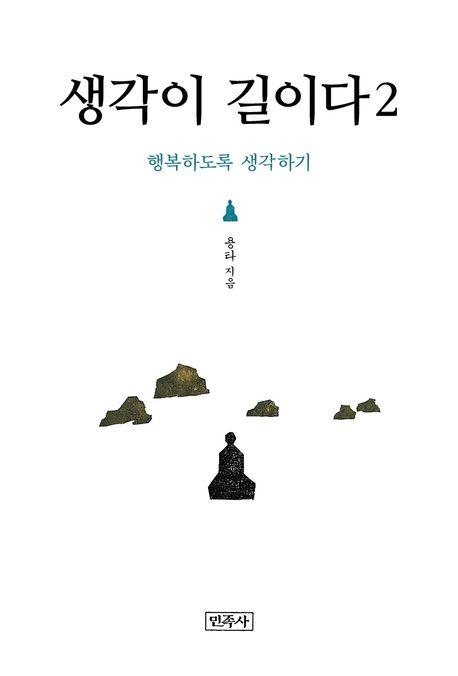
Thinking is the Path 2 and 3 = Yongta, author, and Minjoksa.
The author, a head monk at the Gwisin Temple and a leader of the Happiness Village, as well as a senior member of the Korean Meditation Leaders Association, has spent half a lifetime on the path of practice, compiling short writings. As the subtitle "Thinking for Happiness" suggests, the author asserts that the best way to cultivate a happy, liberated, and virtuous character is through "thinking well."
Following the first volume, "Thinking is the Path," the newly released "Thinking is the Path 2" and "Thinking is the Path 3" each contain 108 short essays. While the writings are easy to read, they are infused with insights that lighten the burdens of life and the heart. Readers are prompted to reflect on whether they have lived in excessive attachment and conflict, whether they have sacrificed happiness in pursuit of perfection, and whether they have prioritized anxiety over gratitude, pushing themselves into a state of turmoil.
The author delivers profound messages through simple phrases like "Do not engage in a war of attrition," "Freedom comes from not getting caught up," "Twisting the mind harms oneself," "I must first become the Buddha," "Do not be attached," and "Accept positively first." These are not mere words of comfort or optimism but rather a new perspective on life.
Readers naturally find themselves answering the question, "What kind of thoughts am I living with right now?" and come to realize that changing one's life is ultimately about changing one's thoughts, not the environment or circumstances.
"Thinking is the Path 2" encourages readers to introspect their own hearts, while "Thinking is the Path 3" focuses more on how to implement realizations in daily life. It encourages readers to smile and stand tall even when facing negative situations and not to be distracted by a single rotten tree but to appreciate the lush forest surrounding it.
"Simply look at the object in front of you. Then, name that object and look at it again. Do you feel a difference between just looking and looking with a name? Now, assign a positive or negative value to that object. When you assign a positive value, you want to draw it closer; when you assign a negative value, you want to push it away." (From the 'Naming Experiment,' Pages 190-191)
* This article has been translated by AI.

Copyright ⓒ Aju Press All rights reserved.