

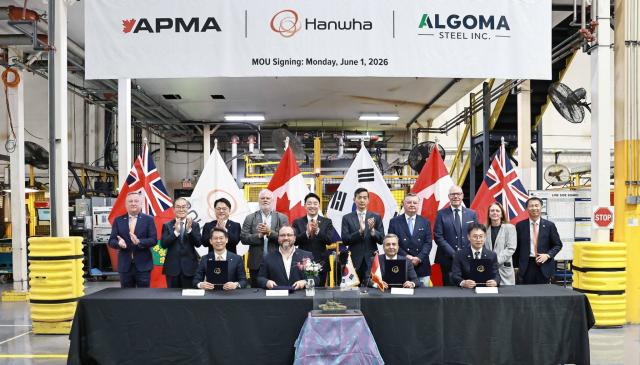
On June 2, the Blue House announced in a joint press release with the Ministry of Trade, Industry and Energy that this agreement was reached with Canada's Ministry of Natural Resources during the 'Korea-Canada Energy Resource Supply Chain Cooperation Forum' held in Ottawa.
The forum, organized by KOTRA, was linked to Kang Hoon-sik's visit to Canada as a special envoy for strategic economic cooperation on behalf of President Lee Jae-myung. Approximately 150 participants from both countries' resource-related governments, associations, and businesses attended the forum.
Kang held a preliminary meeting with Canada's Minister of Natural Resources, Tim Hodge, to discuss energy and resource cooperation strategies.
The Ministry of Trade, Industry and Energy stated, "Both sides recognized that they are reliable partners in the rapidly changing global supply chain environment and agreed to expand mutually beneficial cooperation in areas such as crude oil, LNG, and key minerals."
In the crude oil sector, South Korea plans to increase its imports of Canadian crude oil from 4.88 million barrels last year to a maximum of 16 million barrels this year, with a goal of eventually reaching 20 million barrels annually. This would make South Korea the third-largest destination for Canadian crude oil exports, following the United States and China.
In the LNG sector, Korea Gas Corporation is participating with a 5% stake in the first phase of the LNG Canada project, which imports 700,000 tons annually. Discussions are underway for the second phase, aiming for a final investment decision by the third quarter of this year. If the new 'Ksi Lisims' project, which will add 2 million tons annually, is included, South Korea will secure a stable supply of 3.4 million tons of Canadian LNG each year.
The ministry noted, "In this case, the share of Canadian LNG imports for South Korea is expected to increase from 1.7% in 2025 to 3% by 2031," adding that LNG shipped from Canada's west coast, which poses no geopolitical risks, is expected to arrive in South Korea within 13 days, contributing to supply stability.
Additionally, the government discussed ways to enhance cooperation with Canada, a key mineral producer. Currently, Canada is South Korea's third-largest source of mineral imports, following Australia and Indonesia. Domestic companies have expressed plans to purchase Canadian minerals worth CAD 9.03 billion and invest CAD 130 million in graphite mines.
The two countries agreed to actively support increased investment and purchasing between companies based on their complementary industrial structures, while continuing discussions on policy measures to stabilize supply.
Regarding the joint stockpiling of key minerals, agreed upon during a phone call between the two leaders on May 8, both countries will prepare a joint plan by the end of this year.
Meanwhile, the Korea Institute of Geoscience and Mineral Resources and the Geological Survey of Canada (GSC) signed a 'Joint Research Implementation Agreement on Natural Hydrogen' during the forum.
The ministry stated, "The governments of both countries and KOTRA will support the smooth implementation of cooperation in the areas of crude oil, LNG, and key minerals, including investments and imports, and will work together to resolve any on-site challenges faced by companies."
* This article has been translated by AI.
Copyright ⓒ Aju Press All rights reserved.