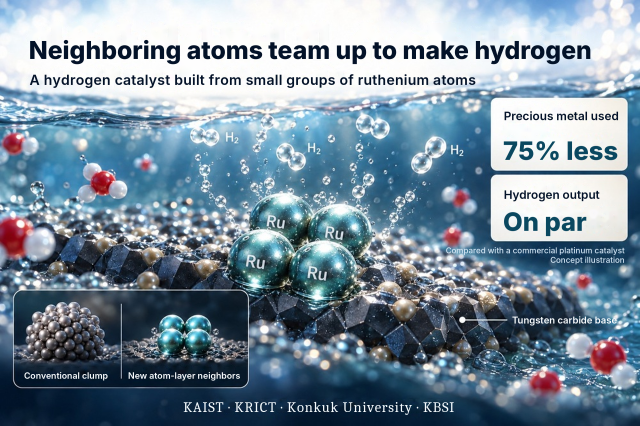
SEOUL, October 28 (AJP) - Researchers in South Korea have built a catalyst that performs about as well as a commercial platinum catalyst while using a quarter of the expensive precious metal such catalysts depend on.
In a lab electrolyzer, the new catalyst carried 9.82 amperes of current per square centimeter of electrode at 2.0 volts and 80 degrees Celsius. A commercial platinum catalyst loaded with four times as much precious metal reached 9.77 amperes under the same conditions.
The Korea Advanced Institute of Science and Technology (KAIST) said Wednesday that a team led by Lee Jin-woo, a professor in its Department of Chemical and Biomolecular Engineering, developed the catalyst. The team included KAIST chemistry professor Kim Hyung-jun, Konkuk University's Lee Jang-yong, Moon Joon-hee at the Korea Basic Science Institute and Kim Sung-jun at the Korea Research Institute of Chemical Technology.
Electrolysis uses electricity to split water into hydrogen and oxygen. When the electricity comes from solar or wind power, the result is known as green hydrogen because making it releases little carbon.
The catalysts that speed up the reaction rely on expensive precious metals, so cutting costs means getting the same performance from less metal.
Most precious metal catalysts take the form of nanoparticles, clumps of many atoms. Atoms buried inside a clump have a hard time taking part in the reaction, so much of the costly metal goes unused.
Chemists have tried to fix this by spreading metal atoms out one at a time, a design called a single-atom catalyst. Almost every atom gets used, but isolated atoms cannot work together, which limits performance in reactions that need neighboring atoms to share the job.
The KAIST team aimed for a middle ground. It arranged ruthenium, a precious metal from the same family as platinum, into small groups laid flat on a surface, one atom thick, a structure the researchers call "atom-layer neighbors."
The team's calculations showed that hydrogen can attach across two neighboring ruthenium atoms, a binding site that isolated atoms have difficulty providing. The researchers attributed the best performance to groups of three or four ruthenium atoms.
Keeping atoms in such small groups is difficult because metal atoms tend to clump. The team used a polymer to keep the ruthenium evenly dispersed at the start of synthesis, then heated the material to about 900 degrees Celsius so the atoms bonded firmly to a base of tungsten carbide.
The base also helps the reaction. Hydroxyl groups, pairs of oxygen and hydrogen atoms on the tungsten carbide surface, strengthen the links between nearby water molecules so hydrogen moves through them faster.
The team tested the catalyst in an anion exchange membrane electrolyzer. This type runs in alkaline conditions, which lets it use cheaper metals on the oxygen-producing electrode, but the hydrogen-producing reaction runs slower than in acidic designs and can need relatively more precious metal to perform well.
The new electrode used 0.10 milligrams of ruthenium per square centimeter, compared with 0.40 milligrams of platinum in the commercial catalyst. Gram for gram, the ruthenium produced about four times as much current.
At a lower 60 degrees Celsius and 1.8 volts, the cell reached 3.65 amperes per square centimeter. That exceeds the 3.0-ampere target for 2026 that the U.S. Department of Energy set for proton exchange membrane electrolyzers, a different type of electrolyzer.
The team ran the cell for 500 hours at 60 degrees Celsius and measured its voltage at 2.0 amperes per square centimeter before and after. The voltage rose about half as much as in the platinum cell, meaning performance slipped less despite a quarter of the precious metal.
Analysis after the test showed that the ruthenium atoms had largely stayed in place rather than drifting and clumping. In a separate test that repeatedly switched the cell on and off, the voltage also rose less than with platinum.
The same production method stabilized a similar structure with iridium, another precious metal. KAIST said this points to possible use with other precious metals, though each metal forms its own structure and needs its own combination of starting materials and base.
Kim Seong-been, a KAIST research professor and one of the study's four co-first authors, said he hoped the work would help "reduce the precious metals that go into hydrogen production equipment" and be used in research to improve other catalysts.
KAIST said the catalyst could help lower the cost of green hydrogen if its performance holds up in larger equipment and over longer operation. The electrolyzer results so far come from a lab cell with an active area of 5 square centimeters.
The team said the next steps are to scale up production, make the catalyst reproducibly and test it on large electrodes, in full electrolyzer stacks, over long-term operation and under the fluctuating output of solar and wind power.
[Reference Information]
Journal/Source: Nature Communications
Title: Stabilizing ruthenium atom layer neighbors through molecular and metal support interactions for water electrolyzers
Link/DOI: https://bit.ly/3U5UO2S

Copyright ⓒ Aju Press All rights reserved.