

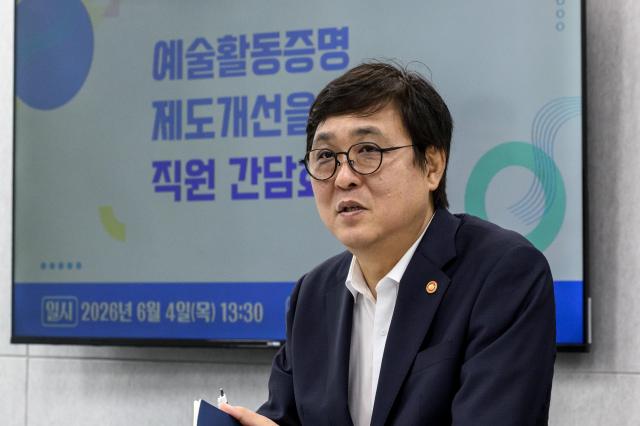
The South Korean government is taking steps to address delays in processing the Arts Activity Certification, a crucial system for supporting artists. With a surge in applications leading to significant backlogs, officials plan to enhance efficiency through staff expansion and the introduction of artificial intelligence (AI) technologies.
During a meeting on June 4 at the Seoul Square Arts Welfare Foundation, Minister of Culture, Sports and Tourism Choi Hwi-young stated, "We will seek to improve the efficiency of the Arts Activity Certification system while adapting flexibly to the changes of the times."
Choi emphasized that the certification serves as a vital safety net for artists, allowing them to focus on their creative work with pride. He noted, "It is essential to ensure the fairness of the system and gain the trust and understanding of the arts community, as it underpins various welfare support programs." He acknowledged the challenges posed by lengthy processing times, burdensome documentation requirements, unclear evaluation criteria, and disconnects with the field.
The Arts Activity Certification is a system that assesses whether artists are engaged in full-time creative activities. It is a prerequisite for applying for various welfare programs, including living stability loans and industrial accident insurance support. Without this certification, artists cannot apply for public support programs, directly impacting their livelihoods. Recently, controversies arose regarding evaluation standards, highlighted by the case of bestselling author Park Sang-young, whose application was rejected five times. Additionally, the typical processing time of two to three months has drawn criticism, as many artists find themselves in a welfare gap.
This year, the expiration of certifications that were automatically extended for up to three years during the COVID-19 pandemic has led to a spike in applications. According to the Arts Welfare Foundation, over 67,000 applications had been submitted by May, already surpassing last year's total of 66,000. The foundation anticipates that the total number of applications for the year will exceed 130,000.
Park Do-won, the team leader responsible for the Arts Activity Certification, explained, "During the pandemic, the validity period was extended for up to three years, and now we are seeing a surge as those certifications expire. We expect this level of applications to continue annually."
A significant challenge remains the shortage of personnel. Currently, only ten staff members, including both full-time and part-time employees, are dedicated to this work. Although the government has recently hired eight additional short-term staff through a supplementary budget, they will require training and adjustment time.
Jeong Yong-wook, head of the Arts Welfare Foundation, noted, "Thanks to the efforts of our team and the entire organization, we have reduced processing times from a maximum of 13 weeks to about eight weeks. We plan to further improve this duration."
Since the beginning of the year, the government has been operating a task force to improve the Arts Activity Certification system, exploring options such as relaxing evaluation criteria, enhancing administrative efficiency, and incorporating AI. A study is also underway to overhaul the system, with findings on administrative efficiency measures, including the introduction of AI-assisted evaluation systems, expected to be released by the end of October.
Minister Choi emphasized the need for various improvements, stating, "We must enhance the system through staff reinforcement and the introduction of new technologies, ensuring that the system itself is trusted and that staff feel a sense of fulfillment in their work."
* This article has been translated by AI.

Copyright ⓒ Aju Press All rights reserved.